Last updated 2026-08-19
TL;DR
Colorado does not have a commercial maple industry, and USDA NASS does not report a state sugarbush cost. If you already have large boxelder or bigtooth maple, a backyard first year runs a few hundred dollars in gear. Selling takes food and tax paper you confirm with CDPHE and Revenue. There is no separate sugarbush license. Planting sugar maple here is a decades-long wait in the wrong native range.
How much does sugarbush cost in Colorado?
There is no Colorado sugarbush cost series. USDA NASS does not treat Colorado as a maple state, so you will not find a state average price per gallon or a per-tap cost in the federal Maple Syrup report [12]. Cash out the door is gear, fuel, bottles, and (only if you sell) whatever registration the health and tax desks require that year.
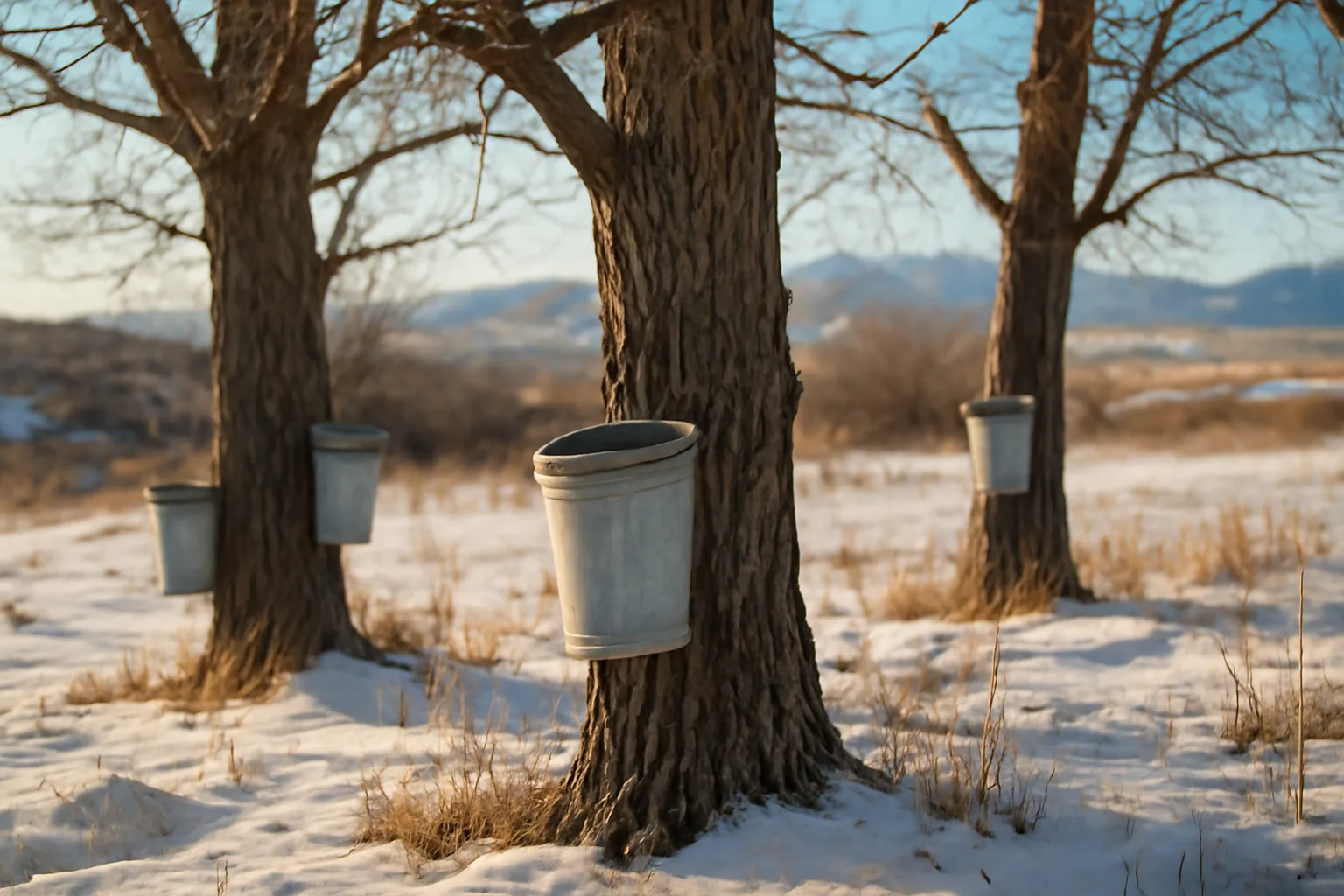
Own tappable trees already? A backyard first season runs a few hundred dollars. Spiles, buckets or bags, a flat pan, filters, a hydrometer, and jars. That is the whole cheap path. Penn State Extension's beginner maple pages are written for the East, but the shopping list is the same list [11].
Cross into a stainless evaporator, mainline tubing, or reverse osmosis and you hit the low thousands fast. I would not spend that in Colorado unless you have already walked the stand and counted large Acer on land you control. The trees decide. The pan does not.
Planting sugar maple for a future sugarbush colorado operation is a 30 to 40 year wait in the wrong native range [1][4]. That is a bad use of money if syrup is the goal. Tap what is already big enough, or skip it.
Home use has no state fee. Selling is a different pile of paper, and those fees move. Confirm them with the board that issues the form. Do not budget a number you saw on a blog.
A useful comparison is other Interior West states with the same tree problem. Sugarbush cost in Idaho and sugarbush cost in Arizona fail the same way. You are not underpaying relative to Vermont. You are in a different forest.
Can you even run a sugarbush in Colorado?
Yes at hobby scale, if you have the right genus and a freeze-thaw stretch. No if you mean a commercial maple county like Addison County, Vermont. USDA NASS does not list Colorado among maple producing states in its Maple Syrup report [12]. That absence is the story.
Sap runs when nights drop below freezing and days rise above it. The Front Range and many mountain valleys get that window. Trees are the limiter. Colorado's major native forest trees are pines, firs, spruce, aspen, oak, and juniper, not sugar maple [13].
You can still boil sap from Acer species that do grow here. Boxelder is common in riparian draws. Bigtooth maple (canyon maple) shows up in western Colorado canyons [2][3]. Planted street maples exist in towns. None of that adds up to an industry.
I would run a backyard boil if I already had the trunks. I would not buy Colorado acreage to build a sugarbush. Land cost here is for views and water, not sap.
Want a state where the forest matches the business? Read sugarbush cost in Connecticut or sugarbush cost in Illinois. Those sit on the real maple map. Colorado does not.
What trees can you tap in Colorado?
Tap boxelder (Acer negundo) and, on the Western Slope, bigtooth maple (Acer grandidentatum) if the trunks are large enough. Sugar maple (Acer saccharum) is not a native Colorado tree on the USDA PLANTS profile, and it is not one of the state's major forest species [1][13]. Planted sugar maples in yards are a maybe, tree by tree.
USDA PLANTS shows boxelder across Colorado. It is a true maple. The sap runs thinner than sugar maple sap, so you boil longer for the same jar [2]. Flavor is stronger and darker. Some people like it. Some do not.
Bigtooth maple is the closest native stand-in. It lives in canyon country in western Colorado [3]. Access is often steep, and many of those stems never reach a comfortable tap diameter. Still, it is Acer. Federal maple sirup identity is written on that genus, not on one eastern species [7].
Aspen is Populus. Cottonwood is Populus. Do not call that maple syrup. Birch is a different boil and a different name. University of Minnesota Extension is blunt that you identify the species first, then tap [14].
Standard eastern guidance still helps on size. Ohio State University Extension's maple production fact sheet treats about 10 inches diameter at breast height as the usual minimum before the first tap, and it uses the old 40 gallons of sap to 1 gallon of syrup figure for sugar maple [10]. Boxelder is often worse than 40 to 1. Plan more boil time.
Walk the property with a diameter tape. Count stems at 10 inches and up. If that number is tiny, your sugarbush cost is "do not start," not "buy an evaporator."
Do you need a license for sugarbush in Colorado?
Not for collecting sap and boiling syrup you eat at home. Colorado has no standalone "sugarbush license." The paper starts when you sell, and even then it is food and tax paper, not a forestry tapping permit on private land.
Home use is just you, a tree you have the right to tap, and a pot. No CDPHE form. No tap quota from Denver.
Sell syrup and you step into cottage food rules or manufactured food rules, plus a state sales tax license if you are making retail sales [5][6]. Which food path applies depends on how you sell and whether maple syrup fits the cottage food list that year. Confirm that in writing with CDPHE. Do not guess from a Facebook group.
Public land is the other license trap. A commercial or organized use of National Forest System land is a special use unless a rule already covers it. The federal text is not subtle. "Before engaging in a special use, persons or entities must submit a proposal to the authorized officer and must obtain a special use authorization from the authorized officer," says 36 CFR 251.50 [9]. Ask the local ranger district before you hang a single bucket on federal bark.
County zoning can also hitch a sugarhouse to a retail food or home-occupation rule. That is a planning desk question, not a maple question.
What paper do you need if you sell the syrup?
Selling means three desks: state food (cottage or manufactured), Colorado Department of Revenue sales tax, and your county health department if anyone consumes product on site [5][6]. There is still no sugarbush stamp.
CDPHE's Cottage Foods Act page is the first document to read. The published eligible list is built around non-potentially hazardous foods such as honey, jams, and certain baked goods [5]. Maple syrup is a high-sugar product, but that is not a reason to skip the call. Ask CDPHE whether your exact product and sales method qualify. If they say no, you are looking at manufactured food registration, not a cottage table.
Cottage food, where it applies, is usually direct to consumer. Wholesale to stores is a different program. Confirm the current sales method rules with the same board. Caps, labels, and course requirements change. I will not invent this year's dollar cap or the current course name.
Retail sales generally need a Colorado sales tax license from the Department of Revenue [6]. File that before the first jar leaves your table. Local special districts can stack tax on top of the state rate. Revenue's lookup tools are the source, not a memory of last year's rate.
Grade and label as U.S. Grade A? Use the USDA AMS maple syrup grade standards, not a color guess from a Facebook photo [8]. Federal identity still matters on the word "maple." 21 CFR 168.140 opens, "Maple sirup is the liquid food derived by concentration and heat treatment of the sap of the maple tree (Acer)" [7]. Boxelder is Acer. Birch is not.
MapleSyrupPath is an independent publisher, not a law firm and not a service company. We do not file your forms. The $129 Tap + Evaporator + Grade Kit is a gear bundle only if you already have trees. It is not a license.
How long does sugarbush take in Colorado?
The boil season is short. Plan on a few weeks, not a few months. On the Front Range that window often sits in late winter into early spring, whenever nights freeze and days thaw. Higher valleys run later. There is no Colorado NASS season table to quote [12].
Setup is the longer part if you are starting from zero. A backyard bucket system on trees you already own can go up in a weekend. Tubing, an arch, and a food-sales path take longer. Penn State Extension frames beginner production as a late-winter craft with most of the labor in boiling, not in drilling [11].
Boil time is physics. Ohio State still teaches the classic 40 to 1 sap-to-syrup ratio for sugar maple [10]. Boxelder sap is usually leaner, so that ratio stretches. A 20 gallon backyard run can eat an afternoon. A 200 gallon day eats the day.
Trees are the real clock. A planted sugar maple can take roughly 30 to 40 years to reach a responsible tap diameter [1][10]. If your plan is "plant now, tap at retirement," do that for shade. Do not call it a business model in Colorado.
First jar from existing trees: one season. First legal farmers-market jar: one season plus however long the food and tax desks take. Nobody honest guarantees that processing time. Ask the board for the current queue.
What does first-year equipment actually cost?
Gear is the only first-year number you can estimate without a state price report. Collection and boiling dominate. Paper does not, unless you sell.
A tiny bucket setup is cheap on purpose. Food-grade spiles, lids, and buckets or bags for 10 to 25 taps. A flat pan you can retire from syrup later. Wool or synthetic filters. A cup hydrometer and a test cup. Jars. Penn State's beginner writeup is the right mental model: start small, learn the boil, do not buy the sugarhouse first [11].
The evaporator is where people light money on fire. A cinder-block arch and a restaurant pan can finish a backyard season. A new commercial evaporator can cost more than the trees are worth in this state. I would not buy stainless finish pans, automatic draw-off, or RO for a Colorado boxelder draw. Not year one. Maybe not ever.
Fuel is the quiet bill. Propane is simple and expensive per hour. Wood is cheap if you already have it and a legal way to burn it. County burn rules are real on the Front Range. Check them.
Used dairy tanks and random galvanized trash cans are how you ruin a batch. Sap is food. Use food-grade collection. That is not romance. It is the health department conversation you do not want.
Need only a tap, a small pan, and a way to read density? Keep the kit tiny. Skip vacuum pumps. Skip 3/16 line. Those tools pay off in the Northeast when you have thousands of taps [11]. You do not.
| Decision | Cheap path | Path I would skip in Colorado |
|---|---|---|
| Trees | Existing boxelder or bigtooth | Planted sugar maple stand |
| Collection | Buckets on a counted handful of trunks | Vacuum tubing for a maybe forest |
| Boiling | Flat pan, wood or propane | New commercial evaporator |
| Sales | Eat it at home | Wholesale without a manufactured-food answer |
Can you tap trees on national forest or BLM land?
Not as a casual weekend project if anyone could call it a commercial use. National Forest special-use rules cover uses of land and resources not already handled by the timber or minerals regulations. You propose, then you wait for an authorization [9].
Call the ranger district that actually manages that slope. White River is not Pike-San Isabel. The local office tells you whether sap is treated as a forest product permit, a special-use permit, or a no. Do not hang buckets first.
BLM field offices run their own forest-product permits. Same rule. Ask first. I would not plan a business on a permit you do not have in hand. Those permissions can be seasonal, limited, or refused.
Private land with written permission is cleaner. City parks and open space are usually a hard no. HOA trees are a fight you will lose.
If the only tappable stems you know are on federal ground, your real first cost is staff time and a permit decision, not spiles.
What does a gallon of Colorado syrup cost to produce?
Nobody has a good Colorado cost-of-production study. The closest honest figures are eastern extension ratios, then you inflate boil time for weaker sap [10][11].
Use 40 gallons of sap per gallon of syrup as the sugar-maple textbook number from Ohio State [10]. Boxelder often needs more sap. If your hydrometer says the sap is thin, believe it. Your fuel cost per finished gallon goes up in a straight line.
Finished density is not a vibe. USDA grade standards and the federal identity standard expect maple syrup in a tight solids range, not a jar of warm sap [7][8]. A hydrometer or refractometer is mandatory gear. Guessing makes mold or sugar sand you cannot sell.
Labor is most of the true cost and none of the cash if you do not pay yourself. A backyard gallon can still be cheap in dollars and expensive in Saturdays. A commercial gallon in Colorado would be worse, because yield per acre is poor compared with a Vermont sugar bush.
I would track sap volume, hours, and fuel for one season before I priced a jar for anyone else. If that back-of-envelope number exceeds what people pay for Vermont Grade A at the store, you are making a craft product, not a commodity.
Do you need a sugarhouse, zoning, or a water right?
Not for a backyard pan on a Saturday. Yes, maybe, if you put up a building, invite customers, or plumb a sink the county can see.
A sugarhouse is just a shed until zoning says it is an agricultural building, a home occupation, or a retail food site. That call is local. Boulder County will not answer like Moffat County. Bring a simple site plan to planning staff and ask. Do not ask maple Facebook.
Retail tasting, by-appointment sales, or a farm-stand structure can trip retail food rules. Those are usually county health, with CDPHE in the background [5]. Confirm before you pour concrete.
Sap is not an irrigation diversion. Collecting sap from your trees is not a water-court play. Washing equipment with well water or a cistern is ordinary residential or agricultural use, but Colorado well permits are picky about new uses. Drilling a well to wash pans for a sales kitchen? Talk to the Division of Water Resources. Rinsing a pan with the hose you already have? You are overthinking it.
I would boil outdoors or in an open shed year one. Buildings can wait until you know the trees actually run.
Is a commercial sugarbush worth it in Colorado?
Almost never, if profit is the test. USDA NASS does not report Colorado maple production, and the state's major tree list is not a maple list [12][13]. You cannot underwrite a loan on a forest that is not there.
A commercial attempt needs thousands of taps, reliable 2 percent sap, and a long cultural season. Colorado gives you scattered Acer, dry air, and a short, jumpy freeze-thaw. Fuel per gallon will look ugly next to sugarbush cost in Connecticut.
Tourism syrup is the only maybe. A jar sold next to a mountain cabin is a souvenir. Price it like that. Do not price it like bulk Vermont drums.
I would not clear pasture to plant sugar maple here. Alkaline soils, drought, and the native range problem are enough [1][4]. If you want western experiments, canyon maple on land you already own is more honest than a catalog of sugar-maple seedlings.
Same pattern shows up in other non-range states. Sugarbush cost in California and sugarbush cost in Alaska are also gear-and-climate stories, not commodity stories. Read them if you are trying to talk yourself into a big evaporator.
How does Colorado compare with real maple states?
It does not, on trees or on paper volume. The NASS Maple Syrup report is a Northeast and Upper Midwest document [12]. Colorado is not late to that list. It is not on it.
Real maple states start with Acer saccharum in the woods. Colorado starts with boxelder in the creek bottom and bigtooth in a canyon [1][2][3][13]. Collection methods can look the same. The yield will not.
Licensing is the one place Colorado is ordinary. Private-land tapping for the kitchen is unlicensed. Selling food is licensed as food. That is also true in Illinois and Connecticut. The difference is that those states have enough syrup for a producers' culture and, in the East, extension maple specialists on speed dial [11].
Moving here from a maple county? Keep your small kit. Leave the 6x16 evaporator on the market back home.
For a last gear check only, MapleSyrupPath keeps a start page at /start. Use it as a checklist. Then go read the CDPHE cottage foods page and call the board that will actually stamp a sales path [5]. Confirm every current fee. Nobody can honestly lock those numbers in an article.
Frequently asked questions
Do you need a license for sugarbush in Colorado?
Not for home sap and home syrup on trees you have a right to tap. Colorado has no separate sugarbush license. Selling triggers food rules (cottage food or manufactured food) and, for retail sales, a Department of Revenue sales tax license. Public land needs a forest-product or special-use answer from the local federal office first. Confirm the current food path with CDPHE before you sell.
How much does sugarbush cost in Colorado?
There is no official Colorado figure. USDA NASS does not report the state. A backyard season on trees you already own runs a few hundred dollars in taps, pans, filters, and jars. Commercial evaporators push you into the thousands and rarely make sense here. Selling adds board fees you must confirm. Planting sugar maple adds decades, not a first-year cost.
How long does sugarbush take in Colorado?
The sap window is a few weeks in late winter or early spring, whenever freeze-thaw holds. A bucket system on existing trees can go up in a weekend. Boiling a batch can take an afternoon, longer with thin boxelder sap. A planted sugar maple stand can take 30 to 40 years to tap. Sales paper takes as long as CDPHE and Revenue take. Nobody should promise that queue.
Can you call boxelder syrup maple syrup in Colorado?
Federal identity in 21 CFR 168.140 defines maple sirup as concentrated sap of the maple tree (Acer). Boxelder is Acer negundo, so the genus fits. Birch and aspen do not. Labels still have to be truthful on grade and ingredients. If you sell, ask CDPHE how they want the product named on a cottage or manufactured-food label before you print lids.
Can you tap aspen or cottonwood for maple syrup?
No. Aspen and cottonwood are Populus, not Acer. You can boil other tree saps as an experiment at home, but the federal maple sirup standard is maple (Acer) sap. Selling that product as maple syrup is a labeling problem. Identify the species first. University of Minnesota Extension's tap-identification guidance is a clear beginner filter.
Can you sell Colorado syrup at a farmers market?
Only after the food path and tax path are real. If CDPHE treats your syrup as a cottage food, market sales may be allowed under that act's direct-to-consumer rules. If it does not, you need the manufactured-food answer instead. Markets also set vendor rules. Get the state answer in writing, then ask the market manager. Confirm the current cottage list rather than assuming honey language covers you.
How many trees do you need for a gallon of syrup?
Ohio State still uses about 40 gallons of sugar-maple sap per finished gallon, and a first tap on a tree about 10 inches in diameter. One healthy eastern maple might give that gallon in a good year, or it might not. Colorado boxelder sap is often weaker, so you need more sap and more trunks. Count 10-inch-plus Acer first. If you cannot, you will not hit a gallon without a long, thin boil.
Is there a Colorado maple producers association?
Not in the way Vermont or New York have one. USDA NASS does not even list Colorado as a maple state. You will find hobby groups and general homesteading clubs, not a state maple institute. For grades, use USDA AMS standards. For sales, use CDPHE and Revenue. Do not wait for a Colorado maple board that does not regulate you.
Do you need a certified kitchen to boil sap in Colorado?
Not to eat the syrup at home. Selling is the fork. Cottage food, if you qualify, is a home-kitchen path with courses and labels CDPHE spells out. If you do not qualify, you are in manufactured or retail food territory, which can mean an inspected kitchen. Confirm which desk owns your exact sales method before you rent commissary time you may not need.
When do you tap on the Front Range versus in the high country?
Front Range freeze-thaw often shows up earlier than high valleys. You tap when nights freeze and days thaw, and you pull taps when buds break and sap goes off-flavor. That can be February into March in town and later above 8,000 feet. There is no state tap-date proclamation. Watch your trees, not a Vermont calendar.
Can you tap trees in a Boulder or Jefferson County open space?
Assume no until a written park rule says yes. County open space and city forestry programs protect trees as public assets. Tapping wounds the cambium. Private land with permission is the clean path. If the only maples you know are in a park, look for another hobby. Fines cost more than buckets.
Does Colorado have its own maple grade law?
Colorado does not run a standalone maple grading program the way some northeastern states do. If you use U.S. Grade A language, follow the USDA AMS maple syrup grade standards (Golden, Amber, Dark, Very Dark). Density still has to match maple syrup, not sap. Federal identity sits in 21 CFR 168.140. Your label also has to satisfy CDPHE if you sell.
Will a few taps get a parcel agricultural tax classification?
Do not plan on it. Colorado agricultural classification is a county assessor determination built around bona fide agricultural use, not a couple of boxelders and a pan. A hobby boil will not convert a residential lot. If someone sold you that story, ask the assessor for the current agricultural classification criteria in that county and read them.
Is bigtooth maple in Colorado worth tapping?
If the stem is large enough and you can reach it legally, yes as a hobby. Acer grandidentatum is a native maple in parts of western Colorado. Many canyon stems stay small, and access can be miserable. It will not underwrite a commercial sugarbush. It can fill a few jars if you already hike that ground and the diameter is there.
Sources
- USDA PLANTS, Acer saccharum plant profile: Sugar maple (Acer saccharum) native status and state distribution do not place it as a Colorado native forest species.
- USDA PLANTS, Acer negundo plant profile: Boxelder (Acer negundo) is a maple species with a native distribution that includes Colorado.
- USDA PLANTS, Acer grandidentatum plant profile: Bigtooth maple (Acer grandidentatum) occurs in the western United States, including parts of Colorado.
- USDA Forest Service FEIS, Acer saccharum: Sugar maple's documented distribution is northeastern and north-central North America, not the Colorado Rockies.
- Colorado Department of Public Health and Environment, Cottage Foods Act: Colorado cottage food sales are governed by the Cottage Foods Act page, which lists eligible home-produced foods and the CDPHE rules for that path.
- Colorado Department of Revenue, Sales tax license: Retail sellers in Colorado need a state sales tax license issued through the Department of Revenue.
- eCFR, 21 CFR 168.140 Maple sirup: Federal identity standard defines maple sirup as concentrated, heat-treated sap of the maple tree (Acer).
- USDA AMS, United States Standards for Grades of Maple Syrup: USDA grade standards classify Grade A maple syrup and set the federal grading language used on labels.
- eCFR, 36 CFR 251.50 Special uses: Uses of National Forest System lands not covered by other parts require a special-use authorization before the activity starts.
- Ohio State University Extension, FOR-36 Maple Syrup Production: Extension maple production guidance uses a roughly 10-inch minimum tappable diameter and about 40 gallons of sap per gallon of sugar-maple syrup.
- Penn State Extension, Maple syrup production for the beginner: Beginner maple production is framed as a small late-winter operation whose main gear and labor are collection and boiling.
- Colorado State Forest Service, Colorado's major tree species: Colorado's listed major forest tree species are conifers, aspen, oak, and similar western species, not sugar maple.