Last updated 2026-08-18
TL;DR
Utah has no state sugarbush board. Maple syrup production falls under Utah Department of Agriculture and Food cottage food and food establishment rules, plus USDA grade standards if you label and sell commercially. Licensing costs and timelines change with your sale volume and channel. Confirm current fees with UDAF before you spend a dollar.
Does Utah have a sugarbush board?
No. Utah has no dedicated sugarbush board, maple syrup board, or maple producers' commission. That surprises people who move here from New England or the Upper Midwest, where producer boards are common and sometimes mandatory. In Utah, maple syrup sits inside general agricultural and food-safety law, run by the Utah Department of Agriculture and Food (UDAF).
That doesn't mean you operate with no rules. Sell syrup direct to consumers from your property or at a farmers market, and cottage food rules apply. Sell wholesale to retailers or restaurants, and you need a food establishment license from UDAF. Label your product as "maple syrup" and sell it across state lines, and USDA grade standards kick in because federal law ties the grade designation to the official federal-state grade standard.
There's no single board to call. There are two or three agencies depending on how you sell, and the rules shift at each threshold.
Do you need a license for sugarbush in Utah?
It depends on what you do with the syrup.
Personal use only, no sales: No license required. Tap trees on land you own or have permission to tap, boil sap, and eat the syrup yourself. No state paperwork.
Cottage food sales: Utah's Homemade Food Act (Utah Code Section 4-5-101 et seq.) allows the sale of certain homemade foods including maple syrup directly to the end consumer, without a food establishment license, up to a gross revenue cap. As of the most recent legislative session that cap was $10,000 annually, but caps change, so confirm the current figure with UDAF before you plan your season [1]. Sales must be direct-to-consumer, meaning no retail store placement and no wholesale. You still label correctly.
Commercial sales beyond cottage food: Cross the revenue threshold or start selling to a third party (grocery store, restaurant, distributor), and you need a UDAF food establishment license. The application goes through UDAF's Food Safety and Inspection program. Fees are set by rule and confirmed annually; check the current fee schedule with UDAF directly [2].
Selling federally graded product across state lines: The USDA Agricultural Marketing Service maple syrup grade standard defines four consumer grades (Grade A Golden, Amber, Dark, and Very Dark) and one processing grade [3]. Label your syrup with a grade designation and you must meet those standards. USDA does not require an AMS inspection certificate to sell within Utah, but several retail buyers demand it. Worth knowing before you commit to a label design.
Land use: Tapping on state or federal land in Utah means a special-use permit from the managing agency. On BLM land that's a permit through the relevant BLM field office [4]. On Forest Service land it's a special-use permit from the relevant national forest unit [5]. On private land you need landowner permission, ideally in writing.
Here's the short version. A hobby tapper on private land with no sales needs zero paperwork. A commercial producer selling wholesale needs a UDAF food establishment license, correct labeling, and maybe a land-use permit.
How much does sugarbush cost in Utah?
Cost splits into two buckets: regulatory fees and physical setup. Neither is small if you do it right.
Regulatory fees
Cottage food registration under the Homemade Food Act carries a low or no application fee in many states. Utah's UDAF cottage food program has historically been no-fee or very low-fee, but confirm this directly with UDAF because rule packages change [1][2].
A UDAF food establishment license fee scales with facility type and operation size. For small processors, fees have historically run roughly $100 to $300 per year, but that range comes from the general fee structure in Utah administrative rule and is not a guarantee of what you'll pay. Confirm the current fee schedule with UDAF [2].
BLM or Forest Service special-use permits for tapping on federal land involve an application fee and, in some cases, a per-tap or per-gallon royalty rate set by the managing agency. Those rates vary by unit and are confirmed at the field office level [4][5].
Physical setup costs
Trees: Tapping your own land means the trees are already there. Buying or leasing sugarbush land in Utah is a real estate question, not a regulatory one.
Taps and buckets or tubing: A basic gravity tubing setup for a small operation (say 50 to 200 taps) runs roughly $200 to $600 in materials depending on tubing grade and fittings. Spiles (taps) cost $0.30 to $1.00 each depending on quality and quantity.
Evaporator: This is the big number. A small flat-pan hobby evaporator can be built for under $300 or bought used for $200 to $800. A small commercial arch-and-pan evaporator (2x4 or 2x6 pan) starts around $1,500 to $4,000 new. Bigger drop-flue or raised-flue units jump to $8,000 and above. These are market estimates from equipment dealers. Get current quotes before you budget.
Filtering and finishing equipment: A good filter press and finishing setup adds $200 to $1,000 depending on volume.
Total first-year cash outlay for a small but real operation (100 to 300 taps, own land, cottage food scale) lands somewhere between $800 and $3,500, driven almost entirely by the evaporator choice. That's the number most people underestimate.
If you want to get organized before you spend, MapleSyrupPath's $129 Tap + Evaporator + Grade Kit at /start covers the equipment decision side in one reference. The regulatory path in this article is separate and costs nothing to read.
How long does sugarbush take in Utah?
Two timelines matter: the licensing timeline and the biological season.
Licensing timeline
Cottage food: UDAF cottage food registration (if required at all) is typically self-certification or a short-form application. Turnaround is usually days, not weeks. Confirm current processing times with UDAF because backlogs happen [2].
Food establishment license: A UDAF food establishment license application involves an inspection of your facility. Real-world timelines vary with application volume and whether your facility needs a physical inspection before approval. Submit 60 to 90 days before you plan to sell commercially, not 10 days.
BLM or Forest Service special-use permit: These are the slow ones. A routine special-use permit application on BLM land can take 30 to 180 days depending on field office workload, environmental review, and whether the activity is categorical exclusion-eligible [4]. Start this in the summer or fall before the season you want to tap.
Biological season in Utah
Maple syrup needs the freeze-thaw temperature cycle that drives sap flow. Utah has bigtooth maple (Acer grandidentatum) and, in some higher-elevation areas, boxelder (Acer negundo), but neither is the sugar maple (Acer saccharum) that dominates commercial production in the Northeast.
Bigtooth maple sap has lower sugar content than sugar maple, typically 1.5 to 2.5 percent sugar by weight versus 2 to 3 percent for sugar maple, which means more sap per gallon of finished syrup and more boiling time [6]. The rule of thumb for sugar maple is 40 gallons of sap per gallon of syrup. With bigtooth maple in Utah you may be looking at 50 to 60 gallons of sap per gallon.
The tapping window along Utah's Wasatch Front and Colorado Plateau elevations typically runs late February through mid-April, depending on elevation and weather. There's no official Utah state tapping date. Watch nighttime temperatures. You want nights below freezing (around 20 to 28 degrees F) and days above freezing (40 to 50 degrees F). When that window closes, sap flow stops and the season is over until next year.
So in practice: your paperwork should be done before February. Your equipment should be ready in January. The syrup season itself runs roughly 4 to 8 weeks.
What maple trees grow in Utah and are they worth tapping?
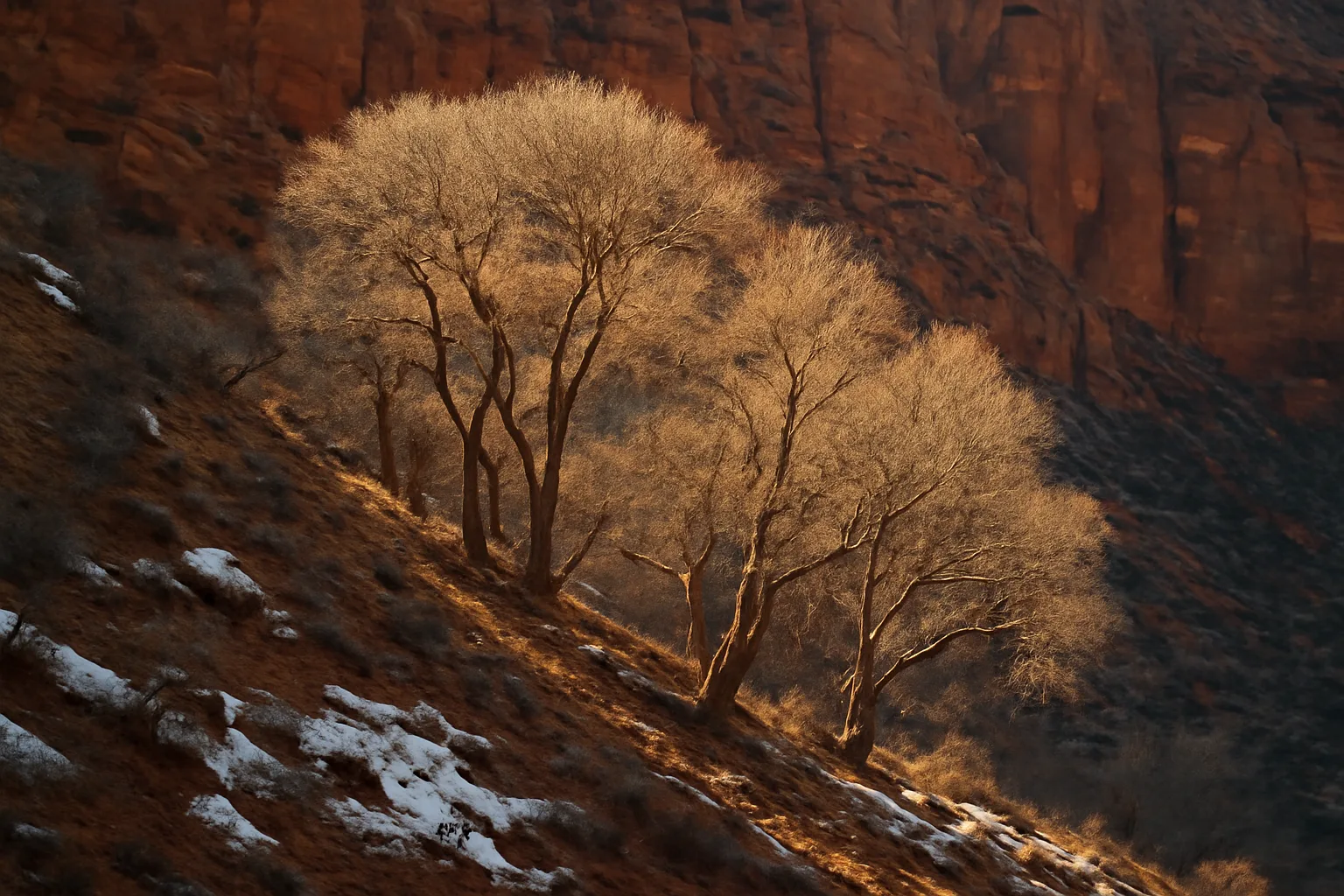
Utah's commercially relevant native maple is bigtooth maple (Acer grandidentatum). It grows on canyon walls, foothills, and montane slopes throughout the Wasatch Range, the Uinta Basin edges, and parts of southern Utah. You've seen it in fall. It's the bright orange-red that lights up Provo Canyon and American Fork Canyon every October.
Boxelder (Acer negundo) is everywhere in Utah, especially along streams and in lower-elevation riparian zones. It's tappable. The syrup is edible. But sugar content is low and the flavor is often described as less complex than sugar or bigtooth maple. Most people who try it once don't make it a business.
Sugar maple (Acer saccharum) doesn't grow wild in Utah. You can plant it in higher-elevation gardens, and some people have, but it isn't establishing itself in the wild here at any scale.
Whether bigtooth maple is worth tapping for anything beyond personal use and small direct sales is genuinely debated among small producers. Nobody has good controlled data on Utah-specific bigtooth maple sugar content across sites and elevations. The closest useful reference is work by Utah State University Extension on the species' range and ecology, which doesn't directly measure syrup yield but does document stand density and site conditions [6]. The honest answer: do a small test tap of 10 to 20 trees before you invest in a commercial evaporator. A season of data on your specific trees beats anyone's average.
How does Utah compare to neighboring states for maple production?
Utah is not a maple syrup state in any commercial sense, and comparing it to neighbors puts that in context.
| State | Native tappable maple species | Commercial production (gallons) | Dedicated maple board or program |
|---|---|---|---|
| Utah | Bigtooth maple, boxelder | Negligible, no USDA data reported | None |
| Colorado | Bigtooth maple, boxelder | Negligible, no USDA data reported | None |
| Idaho | Bigtooth maple (limited range) | Negligible, no USDA data reported | None |
| Arizona | Bigtooth maple (higher elevations) | Negligible, no USDA data reported | None |
| Vermont | Sugar maple (dominant) | ~2 million gallons annually [7] | Vermont Maple Sugar Makers' Association (voluntary) |
| New York | Sugar maple | ~750,000 gallons annually [7] | NYS Maple Producers Association |
The USDA NASS maple syrup survey tracks production only in states where it's commercially significant. Utah, Colorado, Idaho, and Arizona don't appear in that survey because production is too small to measure [7]. That's the honest competitive landscape. Tapping bigtooth maple in Utah is a craft or homestead activity for most people, not a commercial play at any scale that competes with northeastern producers.
If you're in a neighboring state and curious about the rules there, see our guides for sugarbush board in Colorado and sugarbush board in Idaho.
What labeling rules apply to Utah maple syrup?
Sell any product labeled "maple syrup" in Utah and federal grade standards under the USDA AMS rule matter even if you never leave the state, because retail buyers and informed consumers expect them and USDA enforcement authority reaches any product moving in commerce.
The current federal maple syrup grade standard (7 CFR Part 52, effective 2015) establishes four Grade A consumer subgrades: Golden Color and Delicate Taste, Amber Color and Rich Taste, Dark Color and Strong Taste, and Very Dark Color and Strong Taste [3]. The old Grade B designation is gone under this standard.
Utah does not have a separate state maple syrup grade law. The federal standard is effectively what you follow. The USDA AMS rule states that maple syrup "may be graded and inspected" under this standard. The word is "may," not "must," so inspection is voluntary for sales inside Utah [3]. But if you grade your product on the label, the product has to meet the standard for that grade.
For cottage food producers selling direct, the labeling requirements UDAF enforces under Utah Code and administrative rule matter most: product name, net weight, producer name and address, and ingredient statement. Confirm current label requirements with UDAF before you print anything.
Get this right from day one. Don't call your product "maple syrup" if it contains any added sugar, corn syrup, or flavoring. That's misbranding under both federal and state law.
What land-use permits do you need to tap trees in Utah?
This is the question most first-time producers skip, and it's the one most likely to create real legal problems.
Private land: No permit from UDAF or any state agency to tap trees on land you own. Get written permission from the landowner if you're leasing access. A simple written agreement beats a handshake.
State School Trust Lands (SITLA): Utah's School and Institutional Trust Lands Administration manages about 3.4 million acres in Utah [8]. Commercial harvest of any natural resource on SITLA land, including sap, requires a lease or permit from SITLA. Contact them before you tap a single tree on blue-outline school trust parcels.
BLM land: The Bureau of Land Management manages about 22.9 million acres in Utah, roughly 42 percent of the state [4]. Tapping trees on BLM land for anything beyond personal subsistence use is a commercial use and requires a special-use permit or free-use permit depending on scale. The application goes through the relevant BLM field office. Processing time varies; 60 to 180 days is realistic for a complete application [4].
Forest Service land: The Uinta-Wasatch-Cache, Ashley, Manti-La Sal, Dixie, and Fishlake national forests cover significant bigtooth maple habitat in Utah [5]. Tapping on national forest land requires a special-use authorization. The forest supervisor's office for the relevant unit is the starting point. Do not tap on national forest land without authorization. It's a federal violation.
National Park or Monument land: No commercial tapping. Period.
What are the real risks of skipping the paperwork in Utah?
Low-volume hobby producers who never sell anything face essentially zero regulatory risk. The risk scales with commercialization.
Selling syrup without a required food establishment license in Utah is a violation of Utah Code Section 4-5-101 and related rules. UDAF can issue a stop-sale order and fines. For first-time small-scale violations, enforcement tends to start with a warning and correction order rather than a fine, but that's a general pattern, not a guarantee.
Tapping on BLM or Forest Service land without a permit is a federal violation. Penalties range from warning letters to civil fines. On Forest Service land, unauthorized cutting or removal of forest products can trigger penalties under 36 CFR Part 261 [5]. Sap tapping is a gray area in the regulations because it isn't timber removal, but field officers have authority to issue violation notices for unpermitted commercial use.
Mislabeling syrup is both a state and potential federal issue. Call something Grade A Dark when it tests out as processing grade, and that's misbranding.
None of this is meant to scare you out of tapping. It's meant to tell you where the real exposure is so you can decide which paperwork actually matters for your situation.
Where to get help if you're starting sugarbush in Utah
Utah has no maple producer association the way Vermont or New York does. That means you work from general agricultural extension resources and direct agency contact.
Utah State University Extension has published materials on bigtooth maple ecology and Wasatch Range forestry that make useful background even though they aren't syrup-production guides [6]. USU Extension county offices can sometimes connect you with the local agricultural community.
UDAF's Food Safety and Inspection program is the right first call for licensing questions. Reach them directly for current fee schedules and application requirements [2].
The North American Maple Syrup Council (NAMSC) publishes the North American Maple Syrup Producers Manual, currently in its second edition. It covers production methods, food safety, and equipment in detail no state extension guide matches. It's written for sugar maple country, but the principles carry over [9].
The International Maple Syrup Institute (IMSI) maintains the international grading standards framework that the USDA rule drew from. Their resources help anyone trying to understand how grades get assigned in practice [10].
If you want a structured starting kit before you contact any of these agencies, MapleSyrupPath's Tap + Evaporator + Grade Kit at /start covers the equipment and grading side in one organized document. The regulatory paperwork in this article is your job to confirm with the actual agencies. Nobody can do that for you.
Timeline: what to do before your first Utah sap season
Here's the honest sequence for a first-year producer planning to sell at any scale.
Summer or early fall (6 to 8 months before tapping) Identify your maple trees and evaluate the stand. Map which parcels are yours versus public land. If any trees sit on SITLA, BLM, or Forest Service land, start the permit application now. These are the long-lead items.
Fall (4 to 5 months before tapping) Decide your sale channel (personal use only, cottage food direct sales, or commercial wholesale). Contact UDAF to confirm which licensing pathway applies and get current fee schedules. Order or build your evaporator. This is not a January purchase.
November to December (2 to 3 months before tapping) Submit any UDAF food establishment license application if required. Buy taps, tubing or buckets, and filter supplies. Set up and test your evaporator. Do at least one test boil with water so you understand the system before you have sap to lose.
January (1 month before tapping) Confirm any outstanding permits. Prep your label design and have it reviewed against UDAF and USDA requirements. Stage your collection equipment near the sugarbush.
Late February to April (tapping season) Watch nighttime lows. When temps reliably drop below freezing at night and rise above 40 F in the day, sap is moving. Tap at roughly 2 to 3 feet above ground on the south or southeast face of the tree, angling slightly upward. Collect daily when sap runs. Boil promptly. Fresh sap spoils faster than most people expect.
The season ends when trees bud. Buddy sap makes dark, off-flavor syrup. Stop before that happens.
Frequently asked questions
Do you need a license for sugarbush in Utah?
For personal use only, no license is needed. If you sell syrup direct-to-consumer under Utah's cottage food law (Utah Code 4-5-101), you may operate without a food establishment license up to the annual revenue cap. Selling wholesale or to retailers requires a UDAF food establishment license. Tapping on BLM or Forest Service land for commercial purposes requires a federal special-use permit regardless of sale channel. Confirm current thresholds with UDAF.
How much does sugarbush cost in Utah?
Regulatory fees are low to moderate: UDAF food establishment licenses have historically run $100 to $300 per year for small processors, confirm the current schedule with UDAF. Physical setup is the bigger variable. A first-year small operation (100 to 300 taps, own land) typically costs $800 to $3,500 depending almost entirely on the evaporator. Taps and tubing are cheap; a real evaporator is not. Get current equipment quotes before you budget.
How long does sugarbush take in Utah?
The biological season runs roughly late February through mid-April in most Utah elevations, maybe 4 to 8 weeks of active sap flow. Licensing is a separate timeline: cottage food registration is days, a UDAF food establishment license needs 30 to 90 days realistically, and a BLM or Forest Service special-use permit can take 60 to 180 days. Start federal land permit applications in summer or fall before the season you want to tap.
Is bigtooth maple worth tapping in Utah?
It's tappable and makes real maple syrup, but the sugar content (roughly 1.5 to 2.5 percent) is lower than sugar maple, so you need more sap per gallon of finished syrup, typically 50 to 60 gallons versus the 40-gallon rule of thumb for sugar maple. For personal use and small direct sales it's worth it if you have access to a good stand. As a commercial proposition competing with northeastern producers, the economics are difficult. Test 10 to 20 trees for a season before investing heavily.
Can I tap trees on BLM land in Utah?
Yes, but not without a permit for any commercial use. The BLM manages about 22.9 million acres in Utah. Tapping for personal subsistence may fall under free-use provisions depending on scale, but commercial sap collection requires a special-use permit from the relevant BLM field office. Apply 60 to 180 days before you want to start. Tapping without authorization is a federal violation.
What maple syrup grades apply in Utah?
Federal USDA AMS grade standards (7 CFR Part 52, effective 2015) define four Grade A subgrades: Golden/Delicate, Amber/Rich, Dark/Strong, and Very Dark/Strong. Utah has no separate state grade law, so the federal standard is effectively what applies. If you put a grade designation on your label, the product must meet that standard. USDA inspection is voluntary for sales inside Utah but required if you label with a USDA grade for commerce that demands certification.
Does Utah have a maple syrup producers association?
No. Utah has no dedicated maple syrup producers association or sugarbush board. There's no state-level organization equivalent to the Vermont Maple Sugar Makers' Association. The North American Maple Syrup Council (NAMSC) is the closest regional body and publishes the North American Maple Syrup Producers Manual, which is the best general production reference regardless of what state you're in.
What is the Utah cottage food law for maple syrup?
Utah's Homemade Food Act (Utah Code 4-5-101 et seq.) allows direct-to-consumer sales of certain homemade foods, including maple syrup, without a food establishment license up to an annual gross revenue cap. That cap was $10,000 as of the most recent session but can change by legislative action. Sales must be direct to the end consumer; retail placement and wholesale are not permitted under this pathway. Confirm the current cap with UDAF.
How many taps can a bigtooth maple tree in Utah support?
General guidelines from maple production research recommend one tap per tree for trees 10 to 17 inches in diameter (measured at breast height), and two taps for trees 18 inches and above. Never tap a tree under 10 inches diameter. These guidelines come from sugar maple research; bigtooth maple physiology is similar enough that most producers apply the same rules, though controlled Utah-specific data is thin.
Do I need a permit to tap trees on Utah state land (SITLA)?
Yes. Utah's School and Institutional Trust Lands Administration manages about 3.4 million acres of state land. Any commercial harvest of natural resources, including tree sap, requires a lease or permit from SITLA. There's no blanket free-use provision for sap collection on SITLA land the way there is for personal use on BLM land in some cases. Contact SITLA directly before tapping any blue-outline school trust parcels.
When is the maple sap season in Utah?
Typically late February through mid-April depending on elevation and yearly weather, but this varies significantly. Sap runs when nights drop below freezing (roughly 20 to 28 degrees F) and days rise above freezing (40 to 50 degrees F). At higher elevations the season starts later. There's no official state tapping date; watch the thermometer, not the calendar. The season ends when trees begin to bud, and buddy sap makes off-flavor syrup.
Can I sell Utah maple syrup at a farmers market?
Yes, if you meet the cottage food requirements or hold a UDAF food establishment license, depending on your volume and setup. Direct-to-consumer sales at a farmers market are generally compatible with cottage food status if you stay under the revenue cap and meet labeling requirements. Confirm with UDAF and the specific market's rules, since markets sometimes impose additional insurance or license requirements beyond state minimums.
Is maple syrup production regulated differently in neighboring states?
Yes, each state has its own framework. Colorado and Idaho are similarly thin on maple-specific regulation, with production governed by general cottage food and food safety law rather than dedicated maple programs. States like Vermont and New York have active producer associations and more developed extension resources, though no state legally requires board membership. See our guides for neighboring states including sugarbush board in Colorado and Idaho for state-specific details.
Sources
- Utah State Legislature, Utah Code Section 4-5-101 (Homemade Food Act): Utah's Homemade Food Act permits direct-to-consumer sales of homemade foods including maple syrup up to an annual gross revenue cap without a food establishment license
- Utah Department of Agriculture and Food: UDAF Food Safety and Inspection administers food establishment licensing for commercial maple syrup producers in Utah
- USDA Agricultural Marketing Service, United States Standards for Grades of Maple Syrup: Federal grade standards define four Grade A consumer subgrades for maple syrup and state that syrup may be graded and inspected under the standard
- Bureau of Land Management, Utah: Commercial collection of natural resources on BLM land requires a special-use permit; BLM manages approximately 22.9 million acres in Utah
- USDA Forest Service, 36 CFR Part 261 Prohibitions: Unauthorized commercial use of national forest resources, including sap collection, can trigger violation notices under 36 CFR Part 261
- Utah State University Extension, Forestry: Bigtooth maple is native to Utah canyon and foothill areas; sap sugar content is typically lower than sugar maple, affecting syrup yield ratios
- USDA National Agricultural Statistics Service, Maple Syrup Production: Vermont produces approximately 2 million gallons of maple syrup annually; New York produces approximately 750,000 gallons; Utah, Colorado, Idaho, and Arizona do not appear in the survey
- Utah School and Institutional Trust Lands Administration (SITLA): SITLA manages approximately 3.4 million acres of state school trust land in Utah; commercial resource harvest requires a SITLA lease or permit
- North American Maple Syrup Council: The NAMSC Producers Manual is the primary reference for maple syrup production methods, food safety, and equipment across North America
- International Maple Syrup Institute: IMSI maintains the international grading standards framework that informed the 2015 USDA AMS grade standard revision