Last updated 2026-08-21
TL;DR
Georgia does not issue a sugarbush license. If you sell syrup, you follow Georgia Department of Agriculture food rules plus ordinary business filings. NASS does not survey Georgia maple. Sugar maple is scarce in the northern mountains. Red maple is common and weaker. Confirm fees and renewal dates with the issuing board.
Can you run a sugarbush in Georgia at all?
Yes, on private trees you control. No, not as a copy of Vermont. Georgia has no maple producer program, and the federal maple survey does not include the state, so you will not find a quota, a tap allotment, or a sugarbush card to renew.[1]
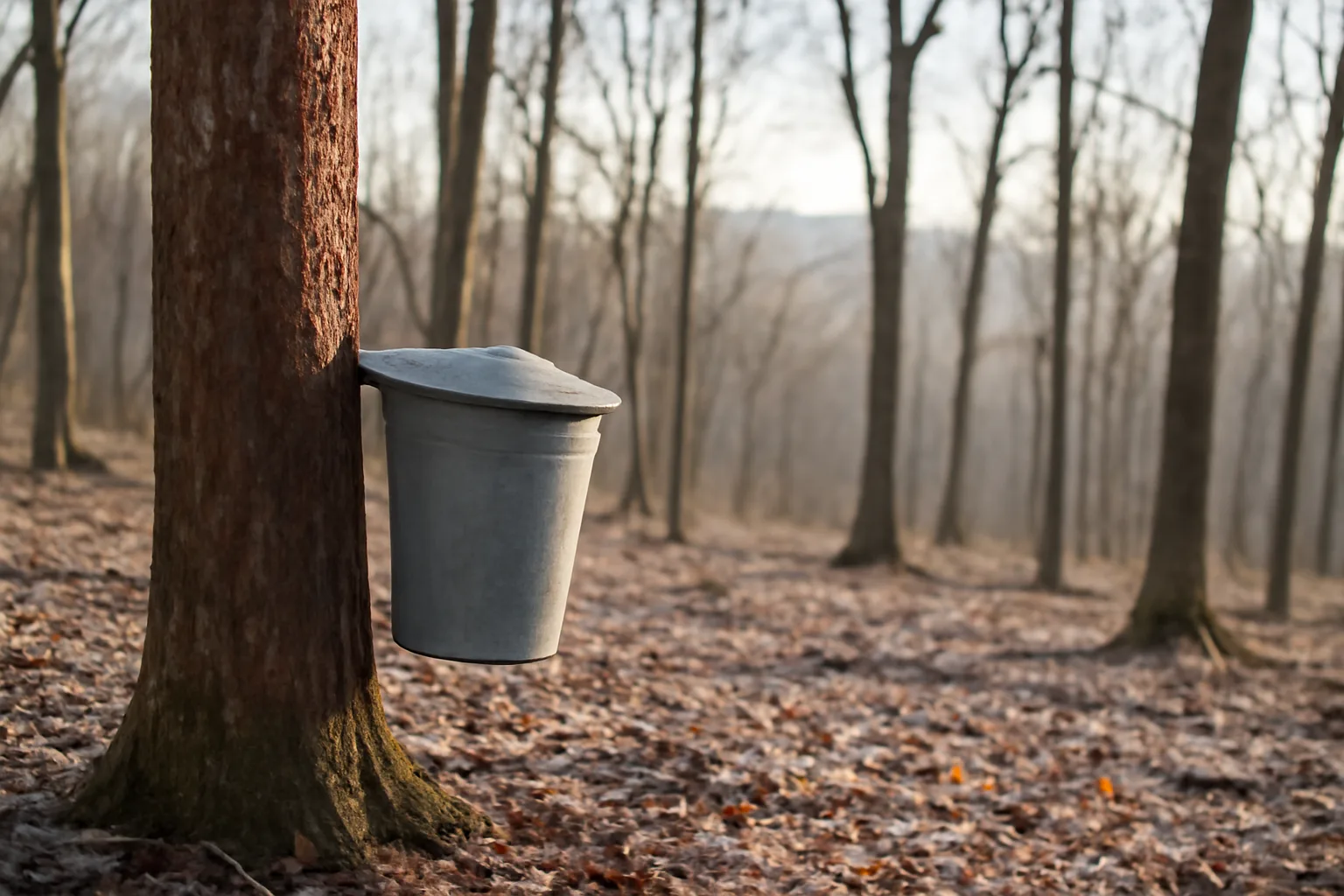
A sugarbush is a stand of maples you tap for sap. In Georgia that stand is usually red maple in a mixed hardwood lot, sometimes a thin scatter of sugar maple on a north slope in the Blue Ridge. You can boil sap for your own table with no food license. The minute you sell syrup, you leave hobby land and enter food law.
I would not plan a commercial sugarhouse here unless I already owned the trees and wanted a side product. The climate window is short. Freeze and thaw nights happen, then they stop. Yields are a guess. Nobody publishes a Georgia sap study that I trust. The closest published production series is the USDA NASS maple report, and it covers the northern and midwestern states that actually ship drums of syrup.[1]
If you came here hunting a state maple stamp, stop. The paper path is ordinary food and tax paper. That is the whole game.
People still tap. I would too, for one ridge of trees and a small pan, before I spent money on a building. Compare that posture with a real maple state writeup like sugarbush renewal in Connecticut if you need a picture of what a surveyed state looks like.
What numbers should you keep in your pocket?
Keep four figures handy. USDA AMS lists four maple syrup grades. Beginner extension guidance often uses 10 inches as a first-tap trunk diameter. At 2 percent sugar, the old rule of 86 says you need about 43 gallons of sap for a gallon of syrup. FDA food facility registration, if it applies to you, renews in even-numbered years.[3][4][9]
Those numbers are not Georgia statutes. They are the portable math every tapper uses. Georgia does not replace them with a local grade board or a local sap table.
USDA AMS lists four maple syrup grades: Golden, Amber, Dark, and Very Dark.[3]
Ohio State Extension beginner guidance uses 10 inches as a common minimum trunk diameter for a first tap.[9]
Sap sweetness is the lever. Sugar maple sap often sits near 2 percent sugar in northern woods. Red maple, which is what most of Georgia actually has, usually runs lighter. Lighter sap means more boiling. More boiling means more fuel and more time. I would measure Brix with a cheap hydrometer on the first run instead of believing a northern average.
Do not memorize a Georgia license fee from a blog. Fees move. The board that takes the money is the only source I would trust for the current amount.
Do you need a license for sugarbush in Georgia?
You do not need a maple or sugarbush license. Georgia does not issue one. If you only tap and boil for your household, you need landowner permission and basic care of the trees. If you sell syrup, you need the food and tax paper that any other packaged food seller needs, and you confirm the exact class with the Georgia Department of Agriculture.[8]
That split is the whole licensing answer. Tapping is forestry and property law. Selling is food law.
GDA runs cottage food and manufactured food paths. Maple syrup is a concentrated liquid food, not a cookie. Read the current cottage food product list on the GDA cottage foods page before you assume a home kitchen is legal.[8] I would not assume it. If syrup is not on the allowed list, you are looking at a commercial kitchen and a manufactured food relationship with GDA. Confirm that classification with the Food Safety staff. I cannot honestly lock a license name or a fee here because those are board-controlled facts and they change.
Selling also pulls in a sales and use tax certificate if you make retail or taxable sales, plus whatever city or county occupational tax certificate the tap site sits in.[6] Entity choice is separate. An LLC is optional. Many first-year tappers sell nothing and file nothing beyond, maybe, a county business certificate they did not actually need yet.
If you manufacture, process, pack, or hold syrup for sale beyond a narrow retail or farm exemption, federal food facility registration can apply. The FDA states that "Domestic and foreign facilities that manufacture, process, pack, or hold food for consumption in the United States are required to register with the FDA," with listed exemptions you have to read in the rule, not in a chat window.[4]
I would call GDA first, then the county clerk, then decide if FDA registration is in scope. Do not pay a consultant to tell you that you need a "Georgia maple permit." That product does not exist.
How much does sugarbush cost in Georgia?
There is no official Georgia sugarbush price. Hobby gear for a handful of taps often lands in the low hundreds of dollars if you already have a heat source. A used flat pan, food-grade buckets or bags, spiles, a drill bit, filters, and jars will do. A dedicated evaporator, RO unit, and sugarhouse can run into the tens of thousands. I would not spend the large number here.
Land is the real cost if you do not already own woods in Rabun, Towns, Union, Fannin, or a similar mountain county. Timberland prices move by road frontage and view. I will not invent a per-acre number. Pull current listings and a county tax card.
Fuel will surprise you if your sap is thin. Propane and wood both work. Reverse osmosis pays off when you have hundreds of taps and a long season. In Georgia you may get two decent weeks. An RO machine is a waste of money at that scale.
Ohio State’s beginner fact sheet is written for northern hobbyists, but the gear list is the same: tap only trees that meet a sensible diameter, keep the boiling space clean, and finish to density.[9] Density is not a vibe. Use a hydrometer or refractometer.
A cheap way to see if your trees even run is a small tap and pan setup. MapleSyrupPath sells a $129 one-time Tap + Evaporator + Grade Kit if you want that bundle in one box. You can also buy a bit, a few spiles, and a turkey-fryer pan from a farm store and get the same answer from the trees.
Licenses and tax accounts have their own prices. Confirm every dollar with GDA, the Department of Revenue, the Secretary of State if you form an entity, and the county. I will not publish a fee that might be stale by the time you read this.[6][7][8]
Insurance is easy to forget. A farm policy or a product liability rider costs more than the taps. If you sell to the public, I would call my agent before I print labels. That is not legal advice. It is how I would spend money.
How long does sugarbush take in Georgia?
The sap season is short. In the north Georgia mountains you are watching January and February nights that drop below freezing and days that thaw. Some winters barely do that. Some dump a false spring in December and then rain for six weeks. Plan on a few boil days, not a two-month campaign.
Trees are the long clock. A maple is not tappable the year you plant it. Extension beginner sheets commonly wait until the trunk is about 10 inches in diameter.[9] On a decent site that can mean decades, not seasons. If you are planting sugar maple in Georgia heat, you may never get a commercial tree. I would tap what is already standing.
Paper time is a board question. I will not promise a GDA processing time. Ask the Food Safety Division how long your application class is taking this month. County occupational certificates can be same day or a board meeting later, depending on the county. A Georgia LLC filed online with the Secretary of State is often quick, but confirm current processing on the how-to guide before you tell a market manager you are "already legal."[7]
21 CFR 1.230 requires food facility registration renewal from October 1 through December 31 of each even-numbered year.[5]
First boil to first legal sale is not a weekend if you need a commercial kitchen. Finding a licensed space, getting a water story GDA accepts, and finishing labels takes longer than hanging buckets. If you never sell, you can go from first tap to jar the same week the sap runs.
I would give myself a full winter to learn the trees and a separate calendar year to build a sales path. Anyone who sells you a 30-day commercial launch in Georgia maple is selling a story.
Where do maple trees grow in Georgia?
Sugar maple sits on the far southern edge of its range in the Georgia Blue Ridge. The USDA PLANTS profile for Acer saccharum records that species in Georgia, and the Forest Service fire-effects review treats it as a northern and Appalachian tree that thins out as you go south.[2][10] You look on cool, moist slopes, not in a south Georgia pine stand.
Red maple grows almost everywhere in the state. The USDA PLANTS profile for Acer rubrum is the one most Georgia tappers will actually match in the woods.[14] Boxelder is an Acer too. People tap it in a pinch. The syrup can taste odd. I would not build a brand on boxelder.
Walk the tract in leaf-off and again in May. Identify the tree twice. A lot of "maple" on a land listing is sweetgum. Sweetgum is not a maple.
Public land is not a free sugarbush. National forest tapping is a special-use question for the local ranger district. I would not hang a bucket on Chattahoochee-Oconee trees because a blog said sap is a public resource. It is not.
Written permission on private land is cheap insurance. A handshake fades when the land sells. One page, signed, with tap count and season dates, is enough for me.
If your woods are in Alabama or Florida instead, the tree story changes again. Those writeups live at sugarbush renewal in Alabama and sugarbush renewal in Florida.
What food rules apply if you sell Georgia maple syrup?
Selling syrup is selling food. GDA is the first call. Cottage food only covers the products on the current allowed list, made in a home kitchen under that program’s label rules.[8] If maple syrup is not on that list, you do not get to invent a loophole. You move to a licensed processing space and whatever manufactured food license GDA assigns to that activity.
I am not going to paraphrase the cottage list from memory. Open the GDA page. Read the product names. If you still cannot tell, email the division and keep the reply.
Water, finishes, and jars matter. A well that is fine for a house may not be fine for a food plant. GDA will tell you what test or public-water letter they want. Finish syrup hot, filter it, and pack it in clean containers. Maple is high sugar, but dirty packing still makes a nasty jar.
Federal overlay exists if you are a registered facility. FSMA preventive controls can apply to processors, with qualified-facility options for smaller firms. Read the FDA preventive controls page and, if you are small, ask whether you file an attestation instead of a full food-safety plan.[12] That is a size and activity test, not a vibe test.
Farmers markets do not waive food law. A market manager can add rules. They cannot subtract GDA.
If you only gift a few jars to family and never take money, you stay out of most of this. The second you put a price on the jar, act like a food seller.
How do you renew the paper on a Georgia maple operation?
There is no sugarbush renewal form. You renew whatever you actually hold.
GDA food licenses, if you have one, renew on the cycle printed on the certificate or in the renewal notice. Confirm that cycle with the division. I will not guess annual versus calendar-year versus anniversary. Counties often run occupational tax certificates on a January cycle. Confirm with the county that issued yours.
Sales and use tax accounts stay alive if you keep filing returns, including zero returns when the season is dead.[6] Ignoring a zero month is how people get their certificate into a bad state.
FDA facility registration, when it applies, is not a Georgia form. The text of 21 CFR 1.230 says the owner, operator, or agent in charge "must submit a registration renewal to FDA containing the information required under § 1.232 during the period beginning on October 1 and ending on December 31 of each even-numbered year."[5] Miss that window and you have a federal problem on top of any state file.
Set reminders in September of even years for FDA, and set a winter reminder for GDA and the county. Maple season will eat your brain. The renewal date will not move because you were boiling.
If your license class changes because you added wholesale accounts or a second kitchen, that is not a renewal. That is a new conversation with GDA. Call before you take the new order.
Other southern paper paths look similar in spirit and different in the agency name. Sugarbush renewal in Arkansas is the next door version of the same idea.
What other filings sit under the food license?
Entity, tax, and land paper sit under the food file. None of them are maple-specific.
If you want an LLC, the Secretary of State how-to guide is the checklist. Articles, registered agent, and the annual registration are the bones.[7] A sole proprietor selling a few market pints may never need that. I would not form an entity to tap 12 trees.
Sales and use tax registration lives at the Department of Revenue. If your sales are taxable, you collect and remit. If you think farm food is automatically exempt, read the DOR sales-and-use pages rather than a Facebook group.[6] Exemptions are narrow and fact-specific.
IRS farm treatment can apply if maple is part of a real farm. Publication 225 is the farmer’s tax guide and it is the document I would hand an accountant before I called syrup a hobby loss forever.[11] Schedule F versus Schedule C is their call, not mine.
Zoning sits with the county. A backyard hobby pan is one thing. A sugarhouse with a stack and weekend traffic is another. Ask planning before you pour a slab.
Weights and measures can show up if you sell by volume and someone complains. Use marked jars and honest net contents. Federal food labeling rules in 21 CFR Part 101 are the backbone for packaged food identity, net quantity, and the information panel.[15]
That is the stack. Food license, tax account, optional entity, local land use. No maple board in the middle.
How do you grade and label syrup in Georgia?
Georgia does not run a separate maple grade inspection that I can point to. If you use USDA grade names, use them the way USDA wrote them. The United States Standards for Grades of Maple Syrup set Golden Delicate, Amber Rich, Dark, and Very Dark Strong as the color and flavor classes in the current federal standard.[3]
Those words mean color and flavor, not a Georgia permit. A grader kit and good light are enough for an honest jar. If you do not want to grade, you can sell it as maple syrup without a USDA grade line, as long as the rest of the label is truthful. Confirm any GDA label add-ons when you talk to Food Safety.
Federal labels need the common name, net quantity, and the name and place of business of the maker or distributor, plus allergen rules if they apply. Maple syrup itself is not a major allergen under the federal list, but a flavored blend can pick up other ingredients.[15] Do not put a leaf on the label and then pour in cane sugar. That is the fast way to a bad day.
Cottage food, if you are somehow on that path, has its own required statement on the GDA program page. Copy it exactly. Do not tidy the wording.[8]
I would print small batches and date them. Syrup stores well if it is dense and hot-packed. It still crystals, molds on a wet rim, and ferments if you finish light. Density first. Pretty label second.
What is a waste of money in year one?
A vacuum pump on 20 red maples is a waste. So is a stainless RO skid, a 3 by 10 evaporator, and a custom sugarhouse with a tasting bar. Georgia will not feed that gear.
Skip branded bottles until you have boiled more than a few gallons. Skip a trademark search on "Georgia Gold Maple" until you know you can make the same product next February.
Do not buy a "complete commercial license package" from a random form mill. The state already publishes the real forms. GDA, DOR, and the Secretary of State are not hiding them.[6][7][8]
Do not plant 400 sugar maples on a hot piedmont pasture and call it a succession plan. The species profile is a mountain tree at this latitude.[2][10] You will water them and then watch summer cook them.
Do spend money on a drill that makes a clean hole, on filters, and on a hydrometer. Do spend money on a conversation with GDA if you plan to sell. Do spend money on a written tap agreement if the trees are not yours.
If you want a midwestern contrast where maple is a real crop, sugarbush renewal in Illinois is a more serious production story than anything in south Georgia.
How does Georgia stack up against real maple states?
It does not. That is the useful answer. NASS built its maple survey around states that produce enough syrup to measure. Georgia is outside that set.[1] You will not see a Georgia line in the June maple release. You will not see a state average tap yield.
Here is the honest comparison I would draw on a napkin.
| Question | Georgia | Surveyed maple state |
|---|---|---|
| What license is maple-specific? | None | Sometimes a state ag maple or sugarhouse program |
| Who watches packaged syrup? | GDA food staff if you sell | State ag plus food rules |
| Is production in the NASS maple report? | No | Yes |
| Typical season | Short, unreliable freeze-thaw | Longer, still weather-risky |
| Sugar maple supply | Scarce, mountains only | Common on the right sites |
Connecticut and New York live in the surveyed world. Delaware is small and still closer to that belt than we are. If you are choosing land for maple, read sugarbush renewal in Delaware next to this page and notice how fast the tree story changes once you leave the Deep South.
I still think a Georgia hobby sugarbush is worth doing if the trees are already there. I think a Georgia wholesale maple brand is a hard way to make a living. Hold both thoughts.
For a simple gear list and the kit path we keep on this site, see /start. MapleSyrupPath is an independent publisher, not a law firm and not a service company. Confirm every fee, form name, and date with the board that issues the paper.
Frequently asked questions
Do you need a license for sugarbush in Georgia?
No maple-specific license exists. Household tapping needs landowner permission, not a state sugarbush card. Selling syrup pulls you into Georgia Department of Agriculture food rules, plus tax and local business paper if they apply. Confirm the food class with GDA. Confirm tax registration with the Department of Revenue.
How much does sugarbush cost in Georgia?
Hobby gear for a few taps often costs a few hundred dollars if you already have heat. Land, a sugarhouse, and commercial evaporators are the large numbers, and they are not Georgia-set fees. License and tax amounts change. Confirm those with GDA, DOR, the Secretary of State, and your county. I would not buy commercial equipment until sap actually runs.
How long does sugarbush take in Georgia?
Sap may run only a few weeks in a good winter, mostly in January and February in the mountains. Trees need decades to reach a common 10-inch first-tap size. Agency processing times are not something I will guess. Ask GDA and your county for current turnaround. A household boil can happen the same week sap flows.
Is maple syrup a cottage food in Georgia?
Only if it is on the current GDA cottage foods allowed list. Maple syrup is a concentrated liquid, not a standard baked good, so I would not assume a home kitchen is legal. Read the GDA cottage foods page and ask Food Safety in writing. If it is not listed, you need a commercial processing path.
Can I tap trees on the Chattahoochee National Forest?
Not as a casual right. National forest use of that kind is a special-use question for the local ranger district. I would not hang buckets on federal trees without written permission. Tap private trees you own or lease, and put the permission on one signed page with dates and tap counts.
Do I need FDA registration to sell syrup from my farm?
Maybe. Facilities that manufacture, process, pack, or hold food for U.S. consumption generally must register, with exemptions for some retailers and farms. Read 21 CFR Part 1 Subpart H and the FDA registration page against your actual sales path. If you register, renewal runs October 1 to December 31 of even-numbered years.
What maple species grow in Georgia?
Red maple is common across the state. Sugar maple shows up on the southern edge of its range in the north Georgia mountains. Boxelder is present and is a weaker tap. Confirm the tree twice, in winter and in leaf. Sweetgum is not a maple, even when a listing says the woods are mixed hardwoods.
When is sap season in north Georgia?
Watch freeze nights and thaw days, often in January and February. The window is shorter and less reliable than New England. A warm winter can erase it. I would set taps when the forecast actually oscillates across freezing, not on a Vermont calendar date copied from a forum.
Do I need to grade syrup to sell it in Georgia?
Georgia does not run a maple grade board that I can cite. If you print USDA grade names, use the four federal classes in the AMS standard. You can also sell honest maple syrup without a grade line if GDA label rules are met. Confirm any required statements with Food Safety before you print.
Can I sell Georgia maple syrup at a farmers market?
Only if your food class allows it and the market accepts you. A market badge does not replace GDA. Bring whatever license or cottage certificate you actually hold, plus labels that match the program. Ask the market manager for their vendor packet, then ask GDA if that packet conflicts with state food rules.
Does tapping hurt the tree?
A clean, shallow hole in a live tree that is large enough will usually compartmentalize. Over-tapping small trunks is how people damage maples. Beginner extension sheets commonly wait for about 10 inches in diameter before the first tap. Use a sharp bit, do not bleach the hole, and skip a second tap on a marginal tree.
Do I pay sales tax on maple syrup in Georgia?
Retail sales of packaged food can be taxable depending on the item and the buyer. Do not guess from a hobby group. Register if DOR says you must, file the returns, and ask DOR about any farm or food exemption that might apply to your exact facts. Keep the written answer.
What if I only give syrup to friends and never sell it?
Household use and true gifts sit outside the sales path. You still need the right to tap the trees. You still need to finish clean syrup if you do not want a science experiment in the pantry. The food-license stack starts when money, market tables, or wholesale accounts appear.
How do I renew if I already have a GDA food license?
Renew the certificate on the cycle GDA printed for your class. Confirm the date and fee with the division. Renew county occupational paper with the county. File sales-tax returns so the DOR account stays clean. If FDA registration applies, file that renewal in the even-year October through December window.
Sources
- USDA PLANTS Database, Acer saccharum profile: Sugar maple (Acer saccharum) is recorded as occurring in Georgia at the southern edge of its range.
- eCFR, 21 CFR Part 1 Subpart H Registration of Food Facilities: Facilities that manufacture, process, pack, or hold food for consumption in the United States must register with FDA unless an exemption applies.
- eCFR, 21 CFR 1.230 When must registration be renewed?: FDA food facility registration must be renewed from October 1 through December 31 of each even-numbered year.
- Georgia Secretary of State, How to Form an LLC: Georgia LLCs are formed through the Secretary of State process described in the official how-to guide.
- Ohio State University Extension, Maple Syrup Production for the Beginner (F-36): Beginner maple guidance commonly uses a 10-inch trunk diameter as a minimum for a first tap and explains hobby-scale boiling gear.
- USDA Forest Service FEIS, Acer saccharum: Sugar maple is described as a northern and Appalachian species whose distribution thins toward the southern end of the mountains.
- IRS Publication 225, Farmer's Tax Guide: The farmer's tax guide is the IRS reference for whether agricultural activities, including maple, are reported as farm income.
- FDA, FSMA Final Rule for Preventive Controls for Human Food: Food processors may fall under the preventive controls rule, with modified requirements possible for qualified facilities.
- USDA PLANTS Database, Acer rubrum profile: Red maple (Acer rubrum) is widely distributed and is the maple species most Georgia landowners will actually find.
- eCFR, 21 CFR Part 101 Food Labeling: Packaged food sold in the United States must follow federal labeling rules for name, net quantity, and manufacturer information.