Last updated 2026-08-18
TL;DR
Alaska has no maple sugarbush industry. It has birch, and birch syrup is real and growing. You'll need a food establishment permit from the state DEC (roughly $50 to $200 a year), maybe a cottage food exemption instead, and a Special Use Permit if you tap state land. The season is 2 to 3 weeks in April. Startup runs $600 to $3,000 depending on scale.
What does 'sugarbush' actually mean in Alaska?
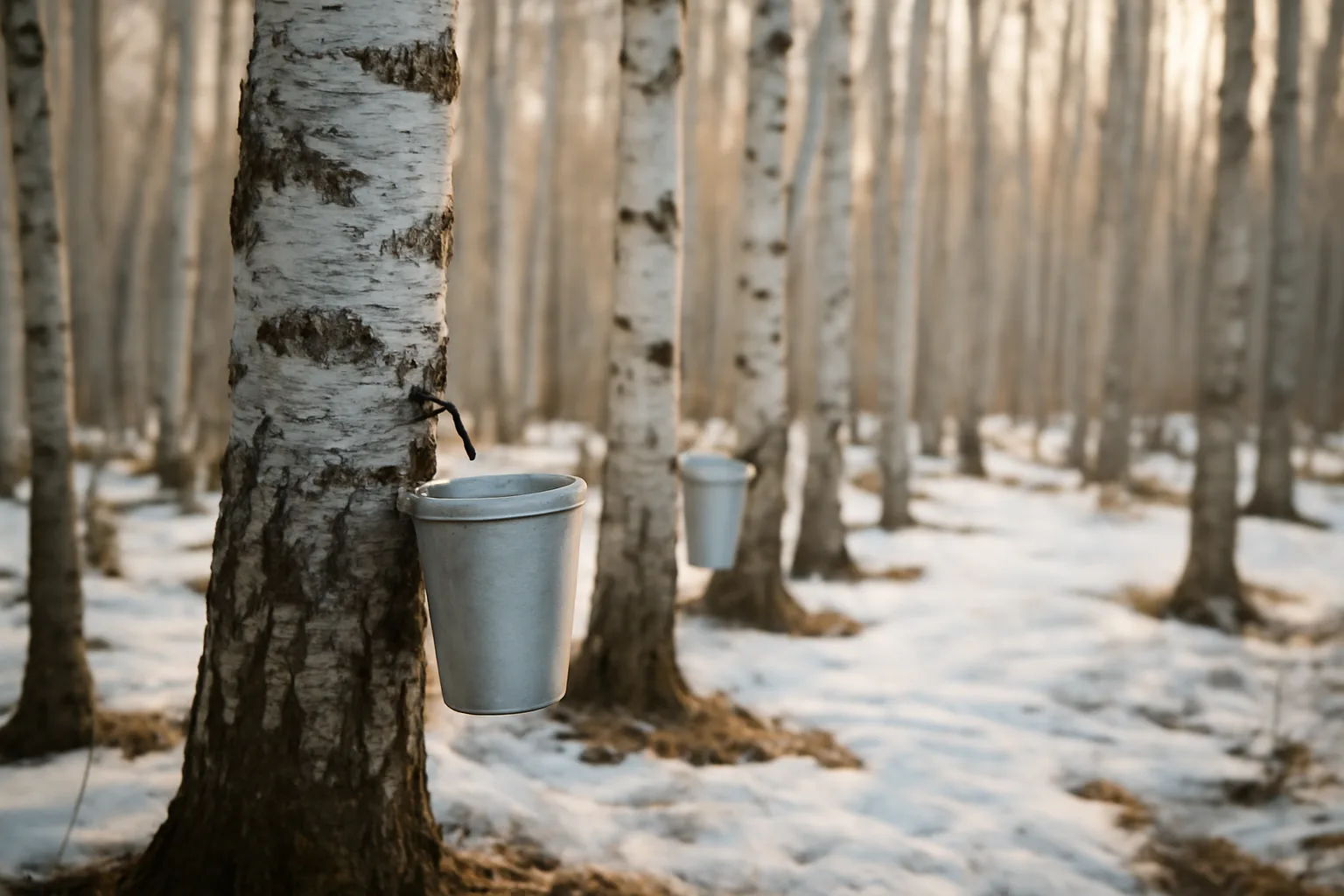
Almost everyone who searches for sugarbush in Alaska is picturing maple syrup. Fair enough, but Alaska has no native maple worth tapping for money. What Alaska has, in real quantity, is paper birch (Betula papyrifera), and birch syrup is the state's actual sap industry.
Birch syrup tastes nothing like maple. It's darker, more mineral, closer to molasses or balsamic than to breakfast syrup. It takes roughly 80 to 100 gallons of birch sap to make one gallon of finished syrup [1], against about 40 gallons for maple. That makes it slow, fuel-hungry, and expensive per finished unit. It's also genuinely valuable: retail birch syrup commonly sells for $30 to $80 per half-pint.
Came here chasing maple? Alaska isn't your state. The climate and the species mix don't support it at any scale that pays. The rest of this guide is about birch syrup, which is the only sap-to-syrup operation that makes practical sense here.
Do you need a license for sugarbush in Alaska?
Yes. If you sell birch syrup to the public, you need at least one state license and possibly two, depending on how and where you sell.
The main one is a food establishment permit from the Alaska Department of Environmental Conservation (DEC). Alaska Statute 17.20 governs food safety and requires food processors, syrup included, to operate under a facility that meets state standards [10]. The DEC's Food Safety and Sanitation Program handles those permits.
Producing a small amount and selling only at farmers markets or straight from home? Alaska's cottage food exemption under AS 17.20.020 may spare you the full food establishment permit, depending on your gross annual sales and the product category [3]. Syrup qualifies as a cottage food in many states because it's low water activity and high sugar. Alaska's DEC still makes the call on birch specifically. Confirm it before you assume you're exempt, because these exemptions carry dollar caps and the caps move.
Beyond the food permit, tapping trees on Alaska State land takes a Special Use Permit from the Alaska Division of Forestry and Fire Protection [4]. Tapping private land you own needs no forestry permit. Tapping trees you don't own needs the landowner's written permission. Federal land (USDA Forest Service or BLM) takes a separate authorization from that agency, and the terms shift by unit.
There is no dedicated "sugarbush license" in Alaska the way some maple states run their programs. The path here runs through food safety and land use, not one agriculture board. Confirm current fees and requirements with the DEC and the Division of Forestry before you file anything.
How much does sugarbush cost in Alaska?
Cost tracks scale almost entirely. Here's an honest breakdown for a first-year birch operation.
The DEC food establishment permit fee varies by facility type and operation size. Alaska's schedule has historically put small food processor permits in the $50 to $200 range per year, but the DEC sets fees by regulation, not statute, so they change. Confirm the current number with the Food Safety and Sanitation Program [2].
A Special Use Permit to tap state land carries a fee that depends on acreage and use type. Small-scale permits have historically started around $50 to $150. Confirm with the regional office [4].
Equipment is where most of your money goes:
| Item | Estimated cost |
|---|---|
| Taps (spiles), 50-100 count | $25-$60 |
| Collection tubing or buckets | $50-$200 |
| Storage tanks for raw sap | $100-$400 |
| Evaporator (small arch/pan setup) | $300-$1,500 |
| Thermometer, filters, hydrometer | $40-$120 |
| Finishing setup (bottling) | $50-$200 |
| Labels, jars for first batch | $50-$150 |
A minimal but working setup runs $600 to $1,000. A proper small-batch evaporator that handles 50 or more gallons of sap a day costs more, easily $1,500 to $3,000 for the unit alone. Birch producers push high sap volumes because of that 80 to 100:1 ratio, so evaporation capacity matters more here than in any maple shop.
Calibrating equipment before you commit? MapleSyrupPath's $129 Tap + Evaporator + Grade Kit walks the core sap collection and evaporation sizing decisions, and that math carries straight over to birch.
Fuel is a real line item. Birch sap runs cold and takes long evaporation times. Budget propane or wood against your expected sap volume. Nobody has clean published data on average Alaska birch fuel cost per finished gallon, but producers quoted in University of Alaska Fairbanks extension materials list it among their top three operating expenses [1].
How long does sugarbush take in Alaska?
The birch sap season in Alaska is short. Genuinely short. Most producers work a 2 to 3 week window in mid-to-late April, and the exact timing moves by year and region [1]. Interior Alaska (Fairbanks) tends to run a little earlier than Southcentral (Matanuska-Susitna Valley, Kenai Peninsula). Coastal and Southeast Alaska have their own microclimates.
Temperature is the trigger. Sap runs best when nights drop below freezing and daytime highs push into the 40s Fahrenheit. Once nights stay warm, the run slows and stops. Birch sap ferments fast once things warm up, so you collect and process under time pressure every single day.
From tree to shelf, the timeline goes like this.
Year one setup (January through March): find your birch stand, secure land permissions or permits, register with the DEC, buy equipment. That's three to four months of paperwork and procurement before you touch a tree.
Sap collection (April, roughly 2 to 4 weeks): install taps, collect daily, evaporate nonstop. This is the sprint. Expect 12-hour days if you're running any real number of taps.
Finishing and bottling (April into May): filter, finish to proper Brix, bottle, label. Selling commercially means your DEC permit has to be active for this step.
Sales and accounting (May through December): retail, online, farmers markets, direct. Sealed birch syrup keeps well, so sales aren't a race.
First permit application to first bottle sold: five to seven months is realistic for a first-year operator who starts in January. Start planning in October or November for the following April and you're in far better shape. Nobody gets into birch syrup and makes money in the same calendar year they decided to start.
What trees can you tap in Alaska, and where can you find them?
Paper birch is the primary sap tree. It's spread across Interior and Southcentral Alaska. Some producers also tap water birch (Betula occidentalis) in small amounts. Alaska does hold some mountain maple (Acer glabrum) and vine maple in Southeast, but neither yields sap in commercial quantity, and Alaska has no maple syrup tradition to speak of.
For land, you have a few options. Private land you own is simplest. Leased private land works if the lease allows it. State land takes a Special Use Permit from the Division of Forestry's regional office for the area you want [4]. Contact that office early, because permits take time and forestry will want a site visit or at least a location description.
On federal land, the USDA Forest Service runs the Tongass National Forest in Southeast and the Chugach National Forest in Southcentral. Both have special use permit programs for small operations, but the terms, fees, and allowed activities differ by ranger district [5]. BLM Alaska manages Interior lands under its own permit structure. Call the district office directly. What applies in one federal unit does not carry to the next.
Alaska Native lands held by regional Native corporations are private land and take direct permission from the corporation. Worth pursuing in regions where birch stands are thick, but the process runs on relationships, not a government form.
What food safety rules apply to birch syrup production in Alaska?
Alaska's food safety rules for syrup producers sit in Title 18 of the Alaska Administrative Code, specifically 18 AAC 31, governing food establishments [6]. The DEC enforces it. A commercial birch operation has to meet standards for the processing space: cleanable surfaces, a proper water source, pest control, adequate sanitation. A food establishment inspection is typically required before your permit issues.
The cottage food exemption under AS 17.20.020 is open to small producers and lets certain non-potentially-hazardous foods sell without a full facility inspection. The law names product categories and caps gross annual revenue from cottage sales [3]. Syrup is generally treated as non-potentially-hazardous thanks to low water activity and high sugar, but the DEC makes the final call on your specific product. Call them. Don't lean on what another state says about its own cottage law.
Labeling is separate. Commercial birch syrup labels have to meet the FDA's food labeling rules under 21 CFR Part 101, including net weight, ingredient statement, and facility name and address [7]. Alaska has no state grading standard for birch syrup the way Vermont has for maple, so there's no Alaska-specific color or grade code to chase. Some producers voluntarily use the International Maple Syrup Institute framework as a quality reference, though it was written for maple and doesn't map cleanly to birch.
How is Alaska birch syrup different from maple syrup in other states?
The production math is harsher. At 80 to 100 gallons of sap per finished gallon [1], birch demands two to two-and-a-half times the fuel, time, and storage of maple at the same output. That's the single biggest reason top-end birch syrup retails for $60 to $80 per 8-ounce bottle. The cost per unit is simply higher.
The regulatory path is easier in one way, harder in another. Alaska has no maple trade board, no mandatory grading rules, no state marketing program like Vermont or New Hampshire runs. No license specific to maple or birch producers. Less paperwork, yes. Also less institutional support. You're on your own more.
Want to see how other states structure licensing and support? The Vermont sugarbush guide is the most detailed example of a mature, fully regulated maple state, and sugarbush licensing in Vermont breaks down what those permits cost and how they renew.
On the market, Alaska birch producers sell into a genuine premium niche. It's a specialty product with a story. Out-of-state buyers, high-end restaurants, and culinary tourism drive demand that a Vermont maple producer chases from a different angle. The catch is that the market is thin. There are very few Alaska birch operations, so there's no shared infrastructure, no co-op, no collective marketing body to lean on.
What equipment do you actually need to start in Alaska?
For birch, the evaporator is the center of everything. That high sap-to-syrup ratio means you have to move a lot of liquid fast. A small hobby maple evaporator (a 2x4-foot pan) will handle tiny test batches. Run 200-plus taps and you need evaporation capacity that matches your daily collection, or you fall behind within two days.
Here's the core list.
Taps (spiles): standard 7/16-inch spiles work for birch, same size as maple. Buy aluminum or stainless. Plastic works but dies sooner.
Collection system: buckets (1.5 to 3 gallon) or gravity-fed tubing. Tubing collects faster but takes more setup. Under 100 taps in year one? Buckets are simpler to manage and easier to inspect for contamination.
Storage tank: you need somewhere to hold sap before the evaporator. Food-grade polyethylene tanks do the job. Size to your daily collection. A 100-tap birch operation can pull 500-plus gallons of sap on a good run day, so size up.
Evaporator: a basic flat-pan arch fired by wood or propane handles small operations. A 2x6-foot arch evaporating 30-plus gallons an hour is a reasonable start for 100 to 200 taps. Expect $500 to $1,500 for a new unit that size, depending on build.
Finishing setup: a propane burner, a smaller finishing pan, and a calibrated thermometer or refractometer to hit Brix (around 66 to 68% for maple; birch is often finished a touch lower, near 65%). A syrup hydrometer runs cheaper than a refractometer and does fine on small batches.
Filters and bottling: Orlon or felt filters to pull sugar sand. Mason jars or food-grade bottles with proper lids. A bottle filler saves real time once volume climbs.
What's the realistic first-year revenue for an Alaska birch syrup operation?
Here's where honesty earns its keep. Nobody should enter birch syrup expecting profit in year one.
A healthy birch yields roughly 8 to 20 gallons of sap over the season [1]. At 90 gallons of sap per gallon of syrup (a midpoint), 100 taps might produce 800 to 2,000 gallons of sap, which finishes to 9 to 22 gallons of syrup. At $60 per 8-ounce bottle, one gallon equals 16 bottles, so 9 to 22 gallons equals 144 to 352 bottles at full retail.
Gross revenue at $60 a bottle: $8,640 to $21,120 in a good year for 100 taps, assuming you sell every bottle at full retail.
You won't. Not in year one. You'll gift some, lose some to bad batches, and burn time building sales channels. First-year equipment and permit costs come straight off that number too. Real first-year net for a 100-tap operation lands closer to break-even or a small loss than a profit.
The Alaska birch producers who make it work treat it as a multi-year build. Equipment gets paid off. Repeat customers and wholesale accounts grow. The 2 to 3 week season caps the upside, and it also caps your ongoing labor.
How do you register your food business and get your permits in the right order?
Start here, in this order.
First, settle your land. Tapping your own property? Skip the forestry step. Need state or federal access? Contact the agency (Division of Forestry regional office or USDA Forest Service ranger district) before anything else. Land access permitting can take 4 to 12 weeks [4][5].
Second, contact the DEC Food Safety and Sanitation Program. Lay out your operation: what you're making, where, and expected annual volume. Ask whether you qualify for the cottage food exemption under AS 17.20.020 or whether you need a full food establishment permit [3]. Get the answer in writing if you can.
Third, if you need the full permit, arrange a facility review. Your processing space (kitchen, cabin, shed, rented commercial kitchen) has to meet basic standards. An inspection is typically required.
Fourth, register your business entity with the Alaska Division of Corporations, Business, and Professional Licensing if you haven't. A sole proprietor operating under anything other than a legal name needs an assumed business name (DBA) registration [8].
Fifth, handle federal requirements: an FDA food facility registration if you cross the applicable thresholds, and correct labeling per 21 CFR Part 101 [7].
Begin all of this in November or December for an April season. Reading this in February with sap running in April? You're likely a year out, not four months.
For a closer look at the license side, the Alaska sugarbush license guide has the current DEC contacts and fee structure broken out on their own.
What resources exist for Alaska birch syrup producers?
Institutional support is thin. This is a small industry.
The University of Alaska Fairbanks Cooperative Extension Service has published some of the only public research on birch sap yields and syrup production in Alaska [1]. The publications are free, and worth reading before you spend a dollar on equipment.
The Alaska Department of Environmental Conservation is your primary state contact for food permits [2]. They answer the phone and tend to help small producers who ask real questions.
The Alaska Division of Forestry and Fire Protection handles state land access permits and can tell you which birch stands are open, what the fee structure looks like, and how long processing runs in your region [4].
There is no Alaska Birch Producers Association the way maple states have trade groups. A few producers have operated in public, including Kahiltna Birchworks (one of the better-known Alaska birch names), but as of this writing there's no formal trade body for the industry. You're building without a peer playbook, which is the challenge and the opening both.
For contrast, see how mature maple states run it, including Vermont's sugarbush renewal process and the Utah sugarbush cost breakdown, which shows what a small but developing state program looks like. Curious how Alaska stacks against other non-maple states just starting sap programs? The Colorado sugarbush license guide is a useful reference.
MapleSyrupPath's $129 Tap + Evaporator + Grade Kit is a practical way to work the equipment sizing math before you buy. It isn't birch-specific, but the evaporation and tap-density math applies directly.
Frequently asked questions
Do you need a license for sugarbush in Alaska?
Yes, if you're selling. Alaska requires a food establishment permit from the DEC under AS 17.20 for commercial syrup production. A cottage food exemption under AS 17.20.020 may apply for small-scale direct sales, but confirm with the DEC whether birch syrup qualifies. If you tap state land, you also need a Special Use Permit from the Alaska Division of Forestry. There is no single dedicated sugarbush license; the requirements come from food safety and land access agencies separately.
How much does sugarbush cost in Alaska?
Budget $600 to $3,000 for a basic first-year birch operation. State permits (DEC food establishment, forestry special use) typically run $50 to $200 each, though fees change, so confirm with the agencies. Equipment, including taps, collection buckets, storage tanks, an evaporator, and bottling supplies, accounts for most of your startup cost. Birch syrup's 80 to 100:1 sap-to-syrup ratio also means meaningful spending on evaporation fuel.
How long does sugarbush take in Alaska?
The birch sap season runs roughly 2 to 3 weeks in mid-to-late April, triggered by nights below freezing and daytime highs in the 40s Fahrenheit. From initial permit applications to first bottles sold, expect five to seven months for a first-year operator who starts planning in January. Decide to start in February for that same April season and you'll almost certainly wait until the following year to operate legally and with proper equipment.
Can you make maple syrup in Alaska?
Not commercially. Alaska has almost no native maple species worth tapping. Mountain maple (Acer glabrum) grows in Southeast Alaska but doesn't produce sap in useful quantity. Birch syrup is the realistic sap-to-syrup operation here. Birch tastes very different from maple, takes 80 to 100 gallons of sap per finished gallon, and commands premium retail prices. If maple syrup is your goal, you'd need a state with sugar maple populations.
What permits do you need to tap trees on state land in Alaska?
A Special Use Permit from the Alaska Division of Forestry and Fire Protection's regional office. The process involves submitting an application describing the location and scope of your operation. Processing times and fees vary by region and project size. Start at least 2 to 3 months before your planned season. Federal land (USDA Forest Service, BLM) requires separate authorization from the managing agency, not the Division of Forestry.
How much birch sap does one tree produce per season in Alaska?
A healthy paper birch typically yields roughly 8 to 20 gallons of sap over the season, according to University of Alaska Fairbanks Extension research. At a conversion ratio of 80 to 100 gallons of sap per gallon of finished syrup, 100 taps might produce 9 to 22 gallons of birch syrup in a good year. Yields vary a lot by tree size, location, weather, and season length. Nobody should plan finances off the high end.
What's the difference between birch syrup and maple syrup production requirements?
The conversion ratio is the biggest operational gap: birch takes 80 to 100 gallons of sap per finished gallon against roughly 40 for maple. That means more evaporation fuel, more storage, and more daily labor during the season. Regulatory differences are smaller in Alaska because there's no dedicated state maple program. Alaska also has no state syrup grading standard, where states like Vermont run mandatory grade classifications.
Does Alaska have a cottage food law that covers birch syrup?
Alaska's cottage food exemption under AS 17.20.020 may cover birch syrup as a non-potentially-hazardous food, but the DEC makes the specific determination. The exemption carries a gross sales cap and product category restrictions. Keep the operation small, direct-to-consumer, and inside the revenue cap and you may skip a full food establishment permit and facility inspection. Confirm directly with the DEC Food Safety and Sanitation Program before assuming you qualify.
What is birch syrup worth at retail in Alaska?
Birch syrup commonly retails for $30 to $80 per half-pint (8 oz), with premium producers at the top end. That's 4 to 10 times the retail price of mass-market maple syrup, reflecting the higher production cost per unit. Direct-to-consumer sales (farmers markets, online, farm stand) usually yield the best margins. Wholesale to retailers or restaurants means lower per-bottle revenue but higher volume and less sales effort.
How many taps should a first-year Alaska birch syrup producer start with?
Most extension guidance and experienced producers suggest 50 to 100 taps in year one. That's enough volume to learn the process, calibrate your evaporation setup, and make a meaningful batch without swamping your capacity. Birch sap runs fast on warm days, so a bigger tap count means more collection labor and more daily evaporation pressure than most beginners expect. Add taps in year two once you know your daily collection ceiling.
Do you need FDA registration to sell birch syrup in Alaska?
FDA food facility registration under 21 U.S.C. 350d is required for facilities that manufacture, process, pack, or hold food for consumption in the United States, with some exemptions for certain small farms and retail food establishments. Selling primarily direct to consumers at your farm or a local farmers market may qualify you for an exemption. Shipping out of state or wholesaling makes registration more likely required. Confirm with the FDA's food facility registration program.
What labeling rules apply to birch syrup sold in Alaska?
Federal labeling rules under 21 CFR Part 101 apply. Labels must carry the product name, net quantity, ingredient list, and the name and address of the manufacturer or distributor. Alaska has no state-specific syrup grading or labeling standard. There's no required grade designation for birch syrup the way maple has Grade A classifications. Some producers voluntarily describe color and flavor profile on labels as a quality signal to buyers.
What is the best region of Alaska to start a birch syrup operation?
The Matanuska-Susitna Valley (Mat-Su) and Interior Alaska near Fairbanks are the most established birch regions, with good paper birch density and manageable road access during the April season. Southcentral Alaska (Kenai Peninsula, Anchorage area) also holds viable birch stands. Southeast Alaska has a different species mix and wetter conditions. Interior operations get colder nights, which can stretch the sap run slightly, but also bring harder road access to remote stands.
Can you tap birch trees on federal land in Alaska?
Yes, with a permit. The USDA Forest Service manages the Tongass and Chugach National Forests and issues special use authorizations for small sap operations. The Bureau of Land Management manages Interior Alaska lands and runs a similar permit process. Terms, fees, and timelines differ by district and land management unit. Contact the specific ranger district or BLM field office where your target stand sits. Do not tap federal land without authorization.
Sources
- University of Alaska Fairbanks Cooperative Extension Service, 'Birch Syrup Production in Alaska': Birch sap requires roughly 80-100 gallons per gallon of finished syrup; a healthy birch tree yields roughly 8-20 gallons of sap per season; fuel is a top operating expense
- Alaska Department of Environmental Conservation, Food Safety and Sanitation Program: Commercial food processors including syrup producers must operate under a DEC food establishment permit in Alaska
- Alaska Statute 17.20.020, Alaska Food, Drug, and Cosmetic Act, cottage food exemption: Alaska's cottage food exemption may apply to small direct-to-consumer food sales including certain non-potentially-hazardous foods like syrup
- Alaska Division of Forestry and Fire Protection, Special Use Permits: Tapping trees on Alaska State land requires a Special Use Permit from the Division of Forestry regional office, with fees varying by acreage and use type
- USDA Forest Service, Special Uses Program: Federal lands managed by the USDA Forest Service require a special use authorization before sap collection operations can begin
- Alaska Administrative Code 18 AAC 31, Food Establishments: 18 AAC 31 governs food establishment standards in Alaska, including facility sanitation and inspection requirements for food processors
- FDA, 21 CFR Part 101, Food Labeling: Commercial food labels including birch syrup must comply with 21 CFR Part 101 requirements for net weight, ingredient statement, and facility name and address
- Alaska Division of Corporations, Business, and Professional Licensing, Business Registration: Alaska business entities operating under an assumed name must register with the Division of Corporations, Business, and Professional Licensing
- Alaska Statute 17.20, Alaska Food, Drug, and Cosmetic Act: AS 17.20 governs food safety in Alaska and requires food processors to comply with state standards enforced by the DEC