Last updated 2026-08-18
TL;DR
Alaska does not issue a dedicated sugarbush license. Small-scale personal maple syrup production requires no state permit. Selling syrup triggers cottage food or food establishment rules through the Alaska Division of Environmental Health. If you tap trees on state land, a forest products permit from DNR is required. Total startup costs vary widely, from under $500 to several thousand dollars.
Do you need a license for sugarbush in Alaska?
No. Alaska does not have a dedicated sugarbush license or a maple syrup producer registration the way Vermont or New York do. There is no state agriculture department form you file that says "sugarbush operator" on it.
That does not mean you operate with zero paperwork. The licensing picture in Alaska breaks into three separate questions: Are you on your own land or state land? Are you selling what you produce? And how much are you selling and how?
Get those three answers right and you know exactly what you need. Get them wrong and you might be tapping trees illegally on state land, or selling food without a required permit. Both carry real consequences.
For personal use only, tapping a few trees on private property you own requires nothing from the state. Alaska has no registration threshold for home producers who do not sell [1].
What permits do you need to tap trees on Alaska state land?
This is the piece most new producers skip. A large share of Alaska is state-managed, and removing any forest product, including sap, from state land without authorization violates Alaska statutes governing state land use.
The Alaska Department of Natural Resources (DNR) issues forest products permits for exactly this situation. DNR's Division of Forestry and Fire Protection issues personal use permits for small-scale removal of forest products (including sap collection) from state land, and commercial removal requires a commercial forest products sale permit [2].
Personal use permits are typically low-cost or free for small volumes, but "small" is defined by DNR and can change. Commercial permits involve an application, a stated volume, and sometimes a per-unit stumpage or resource fee. Confirm current thresholds and fees directly with your regional DNR office before you drive a single tap.
If you are on Native corporation land or federal land (national forest, BLM), those are entirely separate permit systems. The Tongass National Forest, which covers most of Southeast Alaska where maple-adjacent species grow, is managed by the U.S. Forest Service and has its own special use permit process for commercial sap collection [3].
Never assume public land is free to tap.
What tree species can you actually tap in Alaska?
Sugar maple (Acer saccharum) does not grow in Alaska. That matters because "sugarbush" as a term comes from sugar maple production in the Northeast and Upper Midwest.
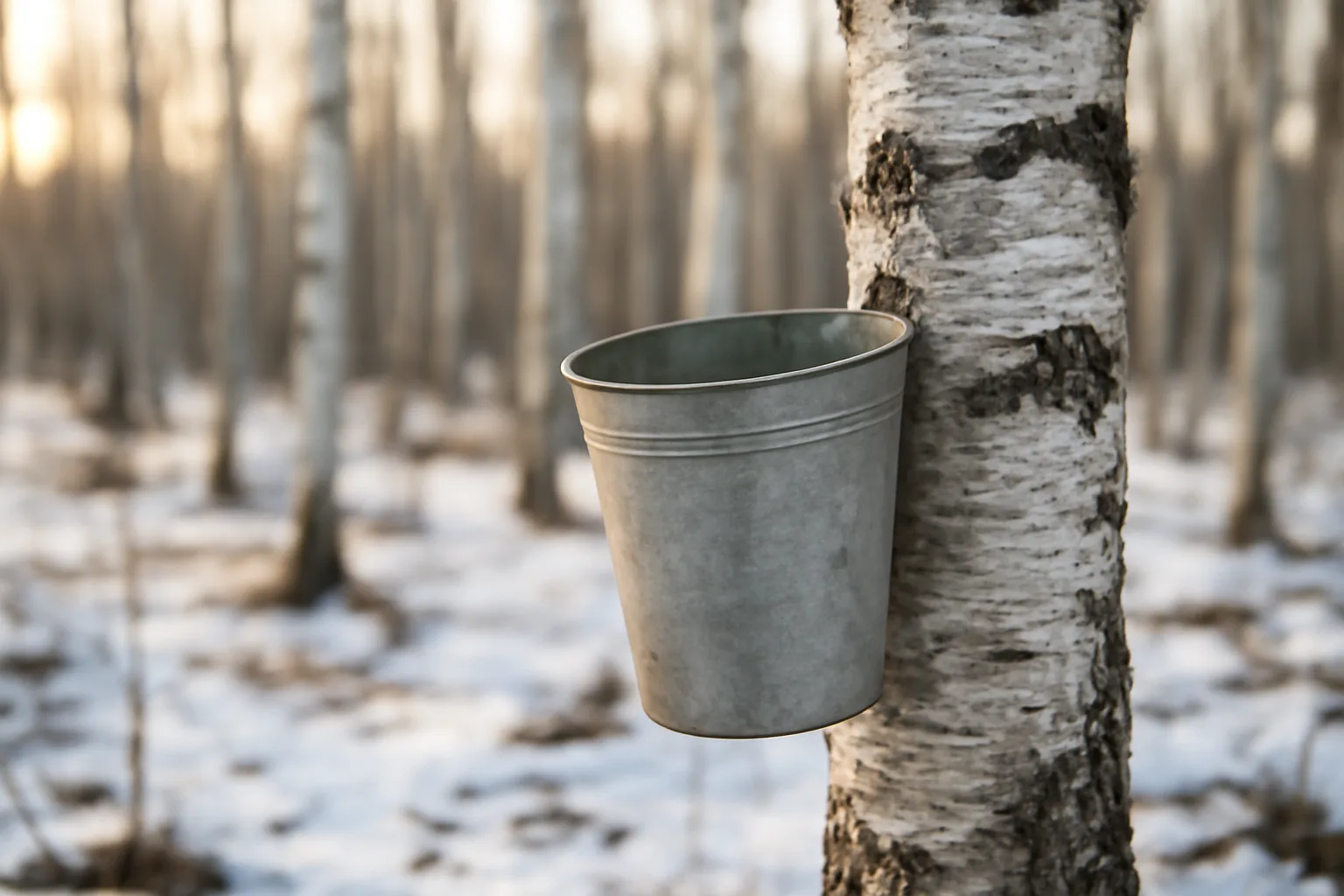
Alaska has several tapable species. Birch (Betula papyrifera, paper birch) is the primary one, and Alaskan birch syrup production is a real, established industry in the state. Birch sap runs in spring, typically March through May depending on elevation and latitude, and takes roughly 80 to 100 gallons of sap to make one gallon of syrup because of the lower sugar content compared to maple [4]. That ratio drives your entire cost math.
Box elder (Acer negundo) grows in parts of Southcentral Alaska and is in the maple family, but yields are low and inconsistent. Some producers also tap white spruce for sap, though spruce syrup is a niche product with a very different flavor profile.
When you see the phrase "sugarbush in Alaska" in a practical context, it almost always means birch syrup production, not maple. The permitting, land, and food safety rules in this article apply to birch syrup as much as to any maple-adjacent operation.
How much does sugarbush cost in Alaska?
Honest answer: more than almost anywhere in the Lower 48, and the birch sap-to-syrup ratio is the biggest reason.
Here is a realistic breakdown for a small first-year birch syrup operation in Alaska:
| Item | Estimated Cost Range | Notes |
|---|---|---|
| Taps and collection equipment (50-tap setup) | $150 - $400 | Includes spiles, food-grade tubing or buckets |
| Evaporator (small hobby unit) | $300 - $1,500 | Pan evaporators start under $500; pre-built arch rigs cost more |
| Fuel (wood or propane for evaporation) | $200 - $800 per season | Birch syrup takes far more evaporation time than maple |
| Food establishment permit (if selling) | $100 - $400/year | Varies by municipality and sales volume; confirm with ADEC [5] |
| DNR forest products permit (state land) | $0 - several hundred | Depends on personal vs. commercial, volume, and region [2] |
| Bottling and labeling | $50 - $300 | For direct sale compliance |
A hobby operation producing for personal use can stay under $1,000 in year one if you already have access to fuel and land. A commercial operation aiming to sell locally will more realistically spend $2,000 to $5,000 before the first jar sells, once you factor in permitting, food safety upgrades, and the sheer fuel cost of the 80:1 reduction.
For equipment, MapleSyrupPath's Tap + Evaporator + Grade Kit at $129 covers starter taps, a small evaporator setup, and grading supplies. It works as a low-risk entry point before you commit to a larger rig. For commercial birch syrup at volume, a more serious evaporator is unavoidable.
Nobody has good Alaska-specific cost data broken out cleanly. The closest published reference is University of Alaska Fairbanks Cooperative Extension work on birch syrup, which documents fuel and labor as the dominant costs in Alaskan sap-to-syrup operations [4].
How long does sugarbush take in Alaska?
Two ways to read that question: the sap season length, and the time from first idea to first legal sale.
The sap season in Alaska is short and unforgiving. Birch sap runs for roughly two to four weeks in spring, typically late March through early May in Southcentral and Interior Alaska, and slightly later at higher elevations or further north [4]. The run is triggered by freezing nights and warming days, and it stops abruptly when temperatures stay above freezing. Miss the window and you wait a full year. That is narrower than the four to eight week maple season in Vermont or New Hampshire.
The time from idea to legal first sale is harder to predict. Here is a realistic timeline:
Month 1: Research land access, contact DNR about your specific parcel or permit needs, contact the Alaska Division of Environmental Health about food handler requirements for your sale method.
Month 2: File any permits. If you need a DNR commercial forest products permit, processing times vary by regional office and workload. If you need a food establishment permit, plan for inspection scheduling.
Month 2 to 3: Set up equipment, source or build an evaporator appropriate for birch syrup volumes.
Year 1 spring: First actual tap season.
If you tap your own private land and sell only at a farmers market under Alaska's cottage food rules, the timeline compresses. But if you need a commercial DNR permit and a food establishment inspection, three to six months of lead time before your first tap season is not unreasonable. Do not plan on tapping in March if you start the paperwork in February.
What food safety rules apply when you sell birch or maple-adjacent syrup in Alaska?
Syrup is not a cottage food item in Alaska under all conditions. Alaska's cottage food law (AS 17.20.020) allows certain low-risk home-produced foods to be sold without a food establishment permit, but the exemption applies to specific product categories and has annual gross sales limits [6].
The Alaska Department of Environmental Conservation (ADEC), specifically the Division of Environmental Health, regulates food establishments. Syrup is generally a processed food product, not a raw agricultural product, which means the moment you boil sap into syrup and sell it, you may need a food establishment permit even at small volume.
ADEC guidance requires that "food establishments that manufacture, process, pack, or hold food for sale" hold a permit from the division [5]. Confirm with ADEC whether your specific product and sales method qualifies for any home processor exemption, because the rules around shelf-stable, high-sugar products like syrup can differ from jam or baked goods.
Selling at a farmers market adds another layer. Most Alaska farmers markets require proof of either cottage food eligibility or a valid food establishment permit before you can sell processed foods at their booths. Check with the specific market manager, more than with ADEC.
If you sell wholesale to a retailer or restaurant, a full food establishment permit is almost certainly required. No wholesale exception exists for syrup in Alaska law as of this writing, but confirm with ADEC before relying on that.
Does Alaska have any maple syrup grading rules?
Alaska does not have its own maple syrup grading statute. The state has not adopted the USDA voluntary maple syrup grading standards (7 CFR Part 52) as a mandatory requirement for in-state sales [7].
If you sell across state lines or to interstate buyers, federal grading and labeling rules under the USDA Agricultural Marketing Act apply. The current USDA grade designations are Grade A (Golden, Amber, Dark, and Very Dark), established under the 2015 revision of the federal maple syrup standards [7].
For birch syrup specifically, there are no USDA or Alaska grade standards at all. Birch syrup producers label their product by flavor profile or Brix level as a convention, not a legal requirement. The International Birch Syrup Producers Association has discussed voluntary standards, but nothing is codified.
The practical result: if you produce and sell birch syrup in Alaska, you have more labeling flexibility than a Vermont maple producer, but you also have less consumer-recognized grading to market with. Clear, accurate labeling of the species (birch, not maple) is both an honest practice and a consumer protection requirement under general food labeling law.
What business registration does a sugarbush operation in Alaska need?
Operating any business in Alaska, including a small syrup operation, typically requires registering with the Alaska Division of Corporations, Business, and Professional Licensing (DCBPL) if you use a business name or operate as a formal entity. A sole proprietor using their own legal name has fewer requirements, but any DBA (doing business as) name needs to be registered [8].
The biennial business license fee in Alaska is $50 for a standard business license (confirm current fee with DCBPL, as fees can change) [8]. That license is separate from any food establishment permit, DNR land permit, or local municipality business license.
Some municipalities, including Anchorage and Fairbanks, have their own local business licensing requirements on top of the state license. If you operate from a home kitchen under any food establishment classification, zoning rules in your municipality may apply. Check with your borough or city planning office.
None of this is unique to syrup production. It is the standard Alaska small food business stack: state business license, applicable food permit, local license if required, and land-access permit if you tap outside private property.
How does Alaska compare to other states for sugarbush licensing?
Alaska sits in an unusual spot: no dedicated agricultural licensing program for syrup, but real complexity from land access and food safety rules.
Compare that to Vermont, which has a formal maple syrup producer registry, an inspection regime, and state grading enforcement built around an industry producing over two million gallons per year [9]. Vermont's system is more bureaucratic, but it also gives producers clear rules and consumer trust infrastructure.
A state like Arizona has no native tapable species and effectively zero sugarbush infrastructure, so the licensing question is moot. Alaska at least has a real birch syrup industry and a small but established set of producers working through these exact questions.
For states with established programs, see our guides to sugarbush license in Vermont and how to start a sugarbush in Vermont as a contrast point. If you want to see how the cottage food and licensing picture looks in other frontier-like states, how to start sugarbush in Arizona and how to start sugarbush in Colorado cover similar terrain.
The general pattern across states without large maple industries: fewer dedicated agriculture rules, but food safety and land access rules still apply and are often less clearly communicated because regulators rarely field these questions.
What is the practical first-year checklist for a sugarbush operation in Alaska?
Here is the sequence that actually makes sense, in order:
1. Confirm land access. Private land you own: proceed. State, federal, or Native corporation land: contact the relevant agency (DNR, USFS, BLM, or the specific Native corporation) before you spend money on equipment.
2. Identify your sap species. Birch is the realistic option for most of Alaska. Know your ratios: 80 to 100 gallons of birch sap per gallon of syrup [4].
3. Decide your sales intent upfront. Personal use only is the simplest path. Any sales, even to neighbors, likely trigger food safety requirements. Contact ADEC before your first sale, not after.
4. File permits early. DNR permits and ADEC food establishment permits both have processing lead times. File in fall or early winter for a spring tap season.
5. Get equipment sized to your realistic sap volume. Underbuying evaporator capacity is the most common first-year mistake in birch syrup. The 80:1 ratio means a 50-tap birch operation can produce 40 to 80 gallons of sap per day during peak run, and you need to evaporate that fast before it ferments.
6. Register your business if selling. Alaska DCBPL business license, and check your municipality.
7. Plan labeling before you bottle. Species name (birch, not maple), net volume, your name and address, and any required permit numbers.
MapleSyrupPath's resource hub at /start has equipment guides and grading references if you are still in the research phase.
For a broader look at how to structure your first year, see how to start sugarbush in Alaska for the full operational guide.
Frequently asked questions
Do you need a license for sugarbush in Alaska?
Alaska does not issue a dedicated sugarbush license. Personal-use sap collection on private land you own requires no state permit. Selling syrup triggers Alaska Division of Environmental Health food permit requirements. Tapping trees on state land requires a DNR forest products permit regardless of whether you sell. The permitting picture is fragmented across agencies, not absent entirely.
How much does sugarbush cost in Alaska?
A personal-use 50-tap birch setup runs roughly $650 to $2,000 in year one, including equipment, fuel, and basic supplies. A commercial operation with DNR and food establishment permits will more realistically spend $2,000 to $5,000 before the first sale. Birch syrup's 80:1 sap-to-syrup ratio makes fuel the dominant recurring cost. University of Alaska Fairbanks Extension documents fuel and labor as the primary cost drivers.
How long does sugarbush take in Alaska?
The birch sap season in Alaska lasts roughly two to four weeks, typically late March through early May. The time from first permit application to first legal sale is three to six months if you need both a DNR land permit and an ADEC food establishment permit. Personal-use tapping on private land with no sales can begin as soon as equipment is ready.
Can you tap sugar maple trees in Alaska?
No. Sugar maple (Acer saccharum) does not grow in Alaska. Birch (Betula papyrifera) is the primary sap species and the basis of Alaska's commercial birch syrup industry. Box elder, which is in the maple family, grows in parts of Southcentral Alaska but yields are low. If you hear 'sugarbush in Alaska,' it almost always means birch syrup production.
Can you sell birch syrup from your home in Alaska under cottage food rules?
Possibly, but not automatically. Alaska's cottage food law allows certain low-risk home-produced foods to be sold without a food establishment permit. Syrup is a processed product and may not qualify under all sale methods. Contact the Alaska Division of Environmental Health before selling any home-produced syrup. Don't assume cottage food covers you without a direct confirmation from ADEC.
Does Alaska require a DNR permit to tap trees on state land?
Yes. Removing any forest product, including sap, from Alaska state land without a permit violates state land use statutes. DNR's Division of Forestry and Fire Protection issues both personal use and commercial forest products permits. Personal use permits are typically low-cost; commercial permits involve an application and may include a resource fee. Contact your regional DNR office for current thresholds.
What sap-to-syrup ratio should I plan for with birch in Alaska?
Budget for 80 to 100 gallons of birch sap per gallon of finished syrup. That is three to four times the ratio for sugar maple. University of Alaska Fairbanks Cooperative Extension documents this range in its birch syrup production work. That ratio is why fuel and evaporation time dominate the cost structure of any Alaska sap operation, even at small scale.
Does Alaska follow USDA maple syrup grading standards?
Alaska has not adopted USDA maple syrup grading as a mandatory state requirement. USDA's Grade A system (Golden, Amber, Dark, Very Dark) applies federally for interstate commerce. Birch syrup has no USDA or state grade standard at all. Alaska producers selling only in-state have more labeling flexibility, but must still accurately identify the species and meet general food labeling requirements.
What agency handles food permits for syrup sales in Alaska?
The Alaska Department of Environmental Conservation, Division of Environmental Health, handles food establishment permitting. If you manufacture, process, or sell syrup, you likely need a permit from this division. Farmers markets and wholesale buyers will ask for proof of permitting. Contact ADEC directly to confirm which permit type applies to your specific operation and sales method.
Do I need a business license to sell birch syrup in Alaska?
Any business operating in Alaska under a business name needs to register with the Alaska Division of Corporations, Business, and Professional Licensing. The state biennial business license fee is around $50, though confirm the current amount with DCBPL. Some municipalities also require a local business license. A sole proprietor using only their legal name has lighter requirements but should still verify with DCBPL.
When is the birch sap season in Alaska?
Birch sap runs for roughly two to four weeks, typically late March through early May in Southcentral and Interior Alaska. Timing varies by elevation and latitude. The run is driven by freeze-thaw cycles and stops when temperatures stay above freezing. The window is considerably shorter than maple sap season in the Northeast, so equipment and permits need to be in place well before spring.
What happens if I tap trees on Alaska state land without a permit?
Removing forest products from state land without authorization violates Alaska land use statutes and can result in fines or removal orders from DNR. The state has enforcement authority over unauthorized resource extraction on state lands. It's not a theoretical risk, particularly if you are tapping commercially. Get the permit before you tap, not after someone flags your operation.
Is there an Alaska birch syrup producer association I can contact?
There is no formal statewide Alaska birch syrup producer association with a public-facing membership program as of this writing, though small producer networks exist informally. The University of Alaska Fairbanks Cooperative Extension Service has published research on birch syrup production economics and is a reliable first contact for technical and regulatory questions specific to Alaska conditions.
Sources
- Alaska Department of Environmental Conservation, Division of Environmental Health, Food Safety and Sanitation Program: Food establishments that manufacture, process, pack, or hold food for sale require a permit from the division
- Alaska Department of Natural Resources, Division of Forestry and Fire Protection: Personal use and commercial removal of forest products from state land require DNR permits
- USDA Forest Service, Tongass National Forest, Special Use Permits: Commercial sap collection on Tongass National Forest land requires a USFS special use permit
- University of Alaska Fairbanks Cooperative Extension Service: Birch sap requires roughly 80 to 100 gallons per gallon of syrup; fuel and labor are the dominant costs; sap season runs late March through early May
- Alaska Department of Environmental Conservation, Division of Environmental Health, Food Establishment Permits: Food establishments that manufacture or process food for sale require a permit; annual permit fees vary by establishment type and volume
- Alaska Statutes, AS 17.20.020, Alaska Food, Drug, and Cosmetic Act, Exemptions: Alaska's cottage food exemption allows certain low-risk home-produced foods to be sold without a food establishment permit under defined conditions
- Alaska Division of Corporations, Business and Professional Licensing, Business License Program: Alaska requires a biennial business license for businesses operating in the state; standard business license fee is $50 biennially
- Vermont Agency of Agriculture, Food and Markets, Maple Program: Vermont maple syrup producers operate under a formal state registry and inspection regime; Vermont produces over two million gallons of maple syrup annually