Last updated 2026-08-18
TL;DR
Alaska has no dedicated sugarbush licensing board. Birch syrup, not maple, is the dominant tree syrup here. First-year operators need a food business license from the state, land-access permission from the relevant federal or state agency, and a cottage food or commercial processing registration depending on how they sell. Costs vary widely by land type and production scale.
Does Alaska have a sugarbush licensing board?
No. Alaska has no sugarbush board, no maple syrup regulatory commission, and no tree-tapping specialty license. If you've been searching for a dedicated state agency that oversees sugarbush operations the way Vermont's Agency of Agriculture handles maple grades, you won't find one here.
What Alaska does have is a general food business licensing framework run by the Department of Environmental Conservation (DEC), plus land-access rules that vary depending on whether your trees are on private land, state land, or federal land (which covers roughly 60 percent of Alaska's total acreage) [1]. Those two tracks, food law and land access, replace what other states handle through a single ag-department license.
The practical result is that getting legal is actually more fragmented than in a traditional maple state, not simpler. You need to work two or three agencies simultaneously instead of one.
Why birch syrup matters more than maple in alaska
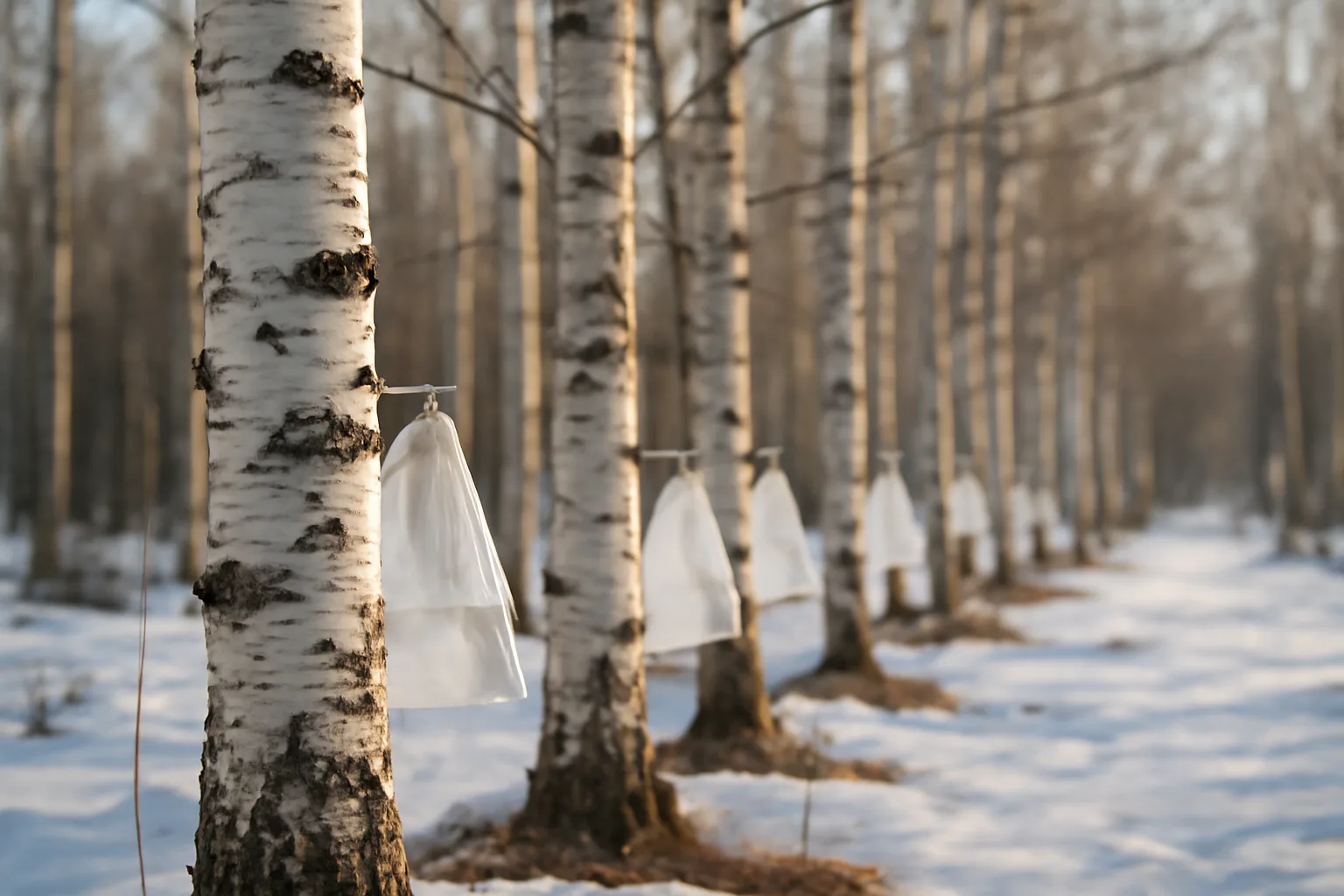
Commercially produced tree syrup in Alaska is almost entirely birch, not maple. Paper birch (Betula papyrifera) grows across interior and southcentral Alaska at latitudes where sugar maple barely survives. Birch sap runs earlier in the season, typically March into April, and it takes roughly 80 to 100 gallons of birch sap to make one gallon of syrup, compared to 40 gallons of maple sap for one gallon of maple syrup [2]. That ratio alone explains why Alaska birch syrup retails for $60 to $200 per pint at the high end.
There are documented maple trees in parts of southeastern Alaska, particularly Sitka and the broader Alexander Archipelago, but the sugar content in Alaskan bigleaf maple sap is low and the tapping season is inconsistent. Nobody has good statewide data on commercial maple sugarbush acreage in Alaska; it is effectively zero in any published agricultural survey.
If you're researching sugarbush in Alaska because you want to produce syrup commercially, plan for birch. The licensing and land-access path described below applies equally to both species.
What land access rules apply to tapping trees in alaska?
This is where it gets complicated, and it depends entirely on who owns the land your trees are on.
Private land. You own it or you have written permission from the owner. No permit required from any public agency. You still need food licensing if you sell the syrup.
Alaska state land. The Alaska Department of Natural Resources (DNR) manages roughly 100 million acres. Commercial harvest of forest products, including sap, from state land requires a Forest Materials Permit or a Material Sale contract depending on volume [3]. Personal-use tapping for home consumption may be exempt, but DNR's official guidance says to contact the regional land office before tapping on state land to confirm whether a permit applies to your specific parcel.
Bureau of Land Management (BLM) land. BLM manages about 72 million acres in Alaska [4]. Small-scale personal tapping is generally addressed under free-use permits for non-commercial purposes, but commercial sap collection requires a Special Forest Product permit. BLM's Alaska state office confirms permit requirements case by case; there is no blanket statewide rule that covers commercial tapping volumes.
US Forest Service (USFS) land. The Tongass and Chugach national forests together cover about 22 million acres [5]. USFS also issues Special Use Permits for commercial harvest of forest products. Personal-use collection of small quantities is typically allowed without a permit, but "small quantities" is defined in each forest's management plan.
The short answer: confirm with DNR, BLM, or USFS before you tap a single tree on public land. Unpermitted commercial harvest of forest products on federal land can result in fines and loss of future permit eligibility.
Do you need a license for sugarbush in alaska?
For the food side of the operation, yes. Alaska requires any business that manufactures or processes food for sale to register with the Division of Environmental Health under the DEC [6]. A small-scale home producer selling only at a farmers market or to neighbors may qualify under Alaska's Cottage Food exemption, which allows certain non-potentially-hazardous foods to be made in a home kitchen and sold directly to consumers without a commercial kitchen license. Birch syrup and maple syrup are generally shelf-stable and have been treated by extension specialists as cottage-food eligible in Alaska, but confirm current DEC guidance because the exemption has size and labeling conditions attached.
If you plan to sell wholesale, to restaurants, or through any indirect channel, you need a commercial food establishment license, which means an inspected processing facility. Fees and inspection schedules: confirm with DEC because they change and the current schedule is on the agency's fee page.
Separately, if you have employees, you need a general Alaska Business License from the Department of Commerce, Community, and Economic Development (DCCED) [7]. That license costs $50 for two years as of the last published fee schedule, but verify before you apply.
So the real answer to "do you need a license" is: probably two or three separate registrations, not one.
How much does sugarbush cost in alaska?
There is no single number because costs stack across land, equipment, and licensing, and Alaska's remoteness adds a freight multiplier that other states don't have.
Here's a realistic breakdown for a first-year birch syrup operation producing under 20 gallons of finished syrup:
| Cost category | Realistic range | Notes |
|---|---|---|
| Alaska Business License | ~$50 per 2 years | DCCED published fee [7] |
| DEC food establishment registration | Varies by facility type | Confirm current fee with DEC [6] |
| DNR/BLM/USFS land permit | $0 to several hundred dollars | Depends on land type and volume |
| Taps, collection bags or tubing | $100 to $400 for 50 taps | Standard sugarbush supply vendors |
| Evaporator or large boiling setup | $500 to $3,000+ | Birch requires very high evaporation capacity |
| Fuel (propane, wood, oil) | High, plan for 2x maple costs | 80-100 gal sap per gal syrup ratio |
| Hydrometer and finishing tools | $50 to $150 | Essential for hitting correct Brix |
| Labels (required by DEC) | $50 to $200 | Must meet Alaska food labeling rules |
Freight to rural Alaska for equipment is the wildest variable. A standard evaporator pan shipped to Fairbanks might cost $200-$400 in freight alone on top of the purchase price. If you're in a fly-in community, triple that estimate.
For context on the equipment side, a starter kit covering taps, a small evaporator, and a grade/Brix testing kit runs around $129 (MapleSyrupPath's own Tap + Evaporator + Grade Kit at /start covers exactly that baseline), which is a reasonable floor before Alaska freight and fuel costs are added.
Total first-year cash outlay for a very small legal operation on private land: realistically $800 to $2,500 before your first gallon is sold. On public land with permit costs and a commercial facility requirement, you could easily be at $3,000 to $5,000+ before production begins.
How long does sugarbush take in alaska?
Two timelines matter here: the sap season itself, and the regulatory setup time.
The sap season. Birch sap in Alaska runs for roughly 2 to 4 weeks, typically in late March through April depending on location [2]. Interior Alaska, around Fairbanks, tends to see sap run earlier than coastal areas. The window is short and weather-dependent. Miss the freeze-thaw cycling that drives sap pressure and you've lost the year. Most experienced Alaska birch producers treat the season as an intensive sprint: daily collection, continuous evaporation, no days off during peak flow.
The regulatory setup time. This is the part people underestimate. Getting a DNR material permit or a BLM Special Forest Product permit can take 30 to 90 days depending on the regional office workload and whether an environmental review is required. DEC food establishment licensing timelines depend on inspection availability, which in rural Alaska can be longer than in Anchorage or Fairbanks.
The practical implication: if you want to sell legally in your first season, start the paperwork in November or December for an April sap run. Do not wait until February. By the time a BLM or DNR permit processes and DEC schedules an inspection, you may have missed the season entirely.
Also plan at least one full season just learning the trees. Birch sap yield varies enormously by tree diameter, health, and microclimate. Extension guidance from the University of Alaska Fairbanks recommends not committing to commercial-scale equipment until you've hand-tapped a small stand for at least one season to calibrate your actual yield [8].
What does the university of alaska say about birch syrup production?
The University of Alaska Fairbanks Cooperative Extension Service has published practical guidance on birch syrup production that is among the most useful starting points for any Alaska operator. Their materials cover tapping diameter thresholds (generally 8-inch DBH minimum for a single tap), sap yield estimation, and evaporation equipment sizing [8].
The extension's published guidance notes that birch sap has a lower sugar content (roughly 1 to 2 percent Brix) compared to maple sap (2 to 3 percent Brix), which explains the high evaporation ratio. This is not a minor operational detail; it fundamentally changes your fuel budget and your equipment sizing. A hobby maple setup is almost never adequate for commercial birch production at the same tree count.
UAF Extension doesn't set regulatory policy, but their production guidance is the closest thing Alaska has to an official operational standard for this crop. Regulators at DEC have been known to reference UAF guidance when evaluating whether a product meets state food safety expectations for water activity and Brix in finished syrup.
How does alaska compare to traditional maple states for licensing?
The contrast is significant. States like Vermont, New York, and Maine have decades-old maple regulatory frameworks with specific grade standards, dedicated agriculture department oversight, and established licensing paths [9][10]. Alaska has none of that infrastructure for tree syrup.
This table compares the key licensing variables:
| Variable | Vermont (maple) | New York (maple) | Alaska (birch/maple) |
|---|---|---|---|
| Dedicated sugarbush board | Yes (VT Agency of Ag) | Yes (NYS Ag & Markets) | No |
| Maple-specific license | Yes | Yes | No |
| Grade standards mandated | Yes (federal + state) | Yes | No (DEC food rules apply generally) |
| Primary land-access agency | Private/state ag land | Private/state ag land | DNR, BLM, USFS |
| Cottage food path | Limited | Limited | Available (confirm with DEC) |
| First-year setup time (estimate) | 1-3 months | 2-4 months | 2-5 months |
For readers who want to see how maple-specific boards operate in lower-48 states, the guides on sugarbush board in connecticut and sugarbush board in utah walk through what a state with active maple infrastructure looks like by comparison.
Alaska's lack of a dedicated board is not a loophole or an advantage. It means less guidance, fewer established precedents, and more work coordinating across multiple agencies.
What food labeling rules apply to alaska birch syrup?
Alaska follows federal food labeling requirements under FDA's 21 CFR Part 101 for packaged food [11], plus any state-specific requirements DEC adds. For tree syrup sold in Alaska, this means:
- Statement of identity ("birch syrup" or "maple syrup" as appropriate)
- Net quantity of contents
- Ingredient statement (if additives are used)
- Name and address of the manufacturer or distributor
- Nutrition facts panel if sold in quantities requiring it
Federal maple syrup grade standards under 7 CFR Part 52 [12] apply to products labeled as "maple syrup" and define Grade A color classes (Golden, Amber, Dark, Very Dark). Birch syrup has no equivalent federal grade standard, so Alaska producers typically use descriptive labeling ("light," "medium," "dark") or simply let color and flavor speak without a grade claim.
DEC can and does inspect labeling during food establishment reviews. Get the label right before your first batch goes to market, not after.
What should you do before your first tap goes in?
Start with land. If you don't have clear permission or a permit for the trees you plan to tap, everything else is premature. Contact DNR, BLM, or USFS depending on land ownership, in writing, well before the season.
Then work the food licensing track in parallel. Download DEC's current food establishment application, read the cottage food exemption language, and call the Anchorage or Fairbanks DEC office to confirm which category your operation falls into. They are generally accessible and will tell you directly what you need.
Meanwhile, read UAF Extension's birch syrup production guide before buying any equipment [8]. The sap-to-syrup ratio for birch is punishing on undersized boilers. Many first-year producers undersize their evaporation setup and end up boiling for 20-hour sessions over an open fire, which works but is brutal and inefficient.
For the equipment baseline, MapleSyrupPath's guide at /start covers what a first-year kit should include and why each component matters, which is worth reading before you shop, even in an atypical state like Alaska.
The state guides for sugarbush in idaho and sugarbush in colorado are useful parallels because both states also rely heavily on federal land-access permits and have limited state-level maple infrastructure.
Where do you actually register and who do you call?
Here are the specific agencies and what each one handles:
Alaska Department of Environmental Conservation, Division of Environmental Health. This is your food licensing authority. Their food business licensing page lists current application types and fees [6]. For cottage food questions, call the Anchorage main office or use the DEC contact form.
Alaska Department of Natural Resources, Division of Forestry. For tapping trees on state land, the regional forestry office covering your area handles Forest Materials Permits [3]. Alaska DNR has regional offices in Anchorage, Fairbanks, Kenai, and several other locations.
Bureau of Land Management, Alaska State Office. For federal BLM land, start with the Alaska state office in Anchorage and ask about Special Forest Products permits [4].
USDA Forest Service, Tongass or Chugach National Forest. For Tongass (southeast Alaska) or Chugach (southcentral Alaska), contact the relevant forest supervisor's office about special use permits [5].
Alaska DCCED, Division of Corporations, Business and Professional Licensing. For the general Alaska Business License, which most businesses need regardless of type [7].
Do not rely on this article's agency descriptions as current. Agency names, phone numbers, and fee structures change. Verify everything directly with the agency before submitting any application or payment.
Frequently asked questions
Do you need a license for sugarbush in alaska?
There is no single sugarbush license in Alaska. You need a food business registration through the Alaska DEC to sell syrup legally, a general business license through DCCED, and a land-use permit from DNR, BLM, or USFS if you tap on public land. Private land with owner permission requires only the food-side registrations. Confirm current requirements with each agency before your first season.
How much does sugarbush cost in alaska?
A very small legal birch syrup operation on private land realistically costs $800 to $2,500 in the first year, covering basic equipment, food licensing, labeling, and fuel. On public land with permit fees, a commercial facility requirement, and Alaska freight costs for equipment, $3,000 to $5,000 or more is a realistic first-year baseline. The high sap-to-syrup ratio for birch (80-100:1) means fuel and evaporation costs are significantly higher than for maple.
How long does sugarbush take in alaska?
The birch sap season runs roughly 2 to 4 weeks in late March through April. Regulatory setup, including land permits from DNR, BLM, or USFS and DEC food establishment licensing, can take 2 to 5 months. Start paperwork in November or December for an April sap run. Missing the permit timeline means missing the season, because the sap waits for no one.
Is there an Alaska sugarbush board that sets maple syrup rules?
No. Alaska has no sugarbush board and no maple-specific regulatory body. The DEC handles food safety for any syrup you sell. Federal grade standards under 7 CFR Part 52 apply if you label a product as maple syrup, but there is no state maple commission equivalent. Birch syrup has no federal grade standard at all.
Can you produce maple syrup commercially in alaska?
Technically yes, but practically the maple species present in Alaska produce sap with low sugar content and unreliable seasonal timing. Commercial maple syrup production is effectively absent in Alaska's agricultural data. Birch syrup is the economically relevant tree syrup in Alaska, and all the established infrastructure, buyer networks, and extension guidance reflects that.
Does alaska allow cottage food sales of birch syrup?
Alaska's cottage food exemption covers certain non-potentially-hazardous foods made in a home kitchen and sold directly to consumers. Birch syrup is shelf-stable and has been informally treated as cottage-food eligible, but you must confirm the current exemption criteria with DEC before relying on it. Size limits, labeling requirements, and sales channel restrictions all apply.
Can I tap trees on federal land in alaska without a permit?
Small-scale personal-use tapping is often allowed without a permit on BLM and USFS land, but commercial sap collection requires a Special Forest Products permit. The line between personal use and commercial activity is not always obvious and each agency defines it differently in each management unit. Contact the relevant regional office before tapping on any federal land, even for small volumes.
What diameter tree should I tap for birch syrup in alaska?
University of Alaska Fairbanks Cooperative Extension guidance generally recommends a minimum of 8 inches DBH (diameter at breast height) for a single tap per birch tree. Tapping smaller trees stresses them and reduces long-term yield from your stand. UAF Extension's birch syrup publications are the primary practical reference for Alaska operators.
How does alaska birch syrup compare to maple syrup in price?
Alaska birch syrup retails significantly higher than maple syrup because of the extreme sap-to-syrup ratio. Retail prices of $60 to $200 per pint are common at the high end, compared to $10 to $20 per pint for typical maple syrup. The production cost differential is real: you're evaporating 80 to 100 gallons of sap per gallon of finished birch syrup versus about 40 gallons for maple.
Does alaska follow federal maple syrup grade standards?
Federal maple syrup grade standards under 7 CFR Part 52 apply to any product labeled as maple syrup sold in interstate commerce or labeled under federal standards. Alaska has not adopted a parallel state maple grade law the way Vermont or New York have. Birch syrup has no equivalent federal grade standard, so Alaska birch syrup labeling relies on descriptive terms rather than official grades.
What extension resources exist for sugarbush in alaska?
The University of Alaska Fairbanks Cooperative Extension Service is the primary practical resource. UAF Extension has published birch syrup production guides covering tapping thresholds, sap yield, evaporation ratios, and equipment sizing. These publications are available through the UAF Extension catalog and are the closest thing Alaska has to an official production standard for tree syrup.
How do I find out if my alaska land needs a DNR forest materials permit?
Contact the Alaska DNR Division of Forestry regional office closest to your parcel. DNR has offices in Anchorage, Fairbanks, and Kenai among other locations. Ask specifically whether your intended use (commercial sap collection) requires a Forest Materials Permit or a Material Sale contract. Get the answer in writing before tapping. Personal-use tapping may be exempt, but the threshold varies by region.
What happens if I sell birch syrup without a food license in alaska?
Selling food without the required DEC registration can result in stop-sale orders, fines, and being barred from selling at farmers markets or to retail buyers. Alaska DEC has enforcement authority over unlicensed food operations. The cottage food exemption provides a legal path for small direct-to-consumer sales, but only if your operation actually meets the exemption criteria.
Are there any alaska-specific sugarbush associations or industry groups?
There is no statewide Alaska birch syrup or sugarbush producers association with a formal regulatory or licensing role. Some informal networks exist among interior Alaska birch syrup producers, particularly around Fairbanks, but nothing comparable to the International Maple Syrup Institute or state maple producers' associations in Vermont or New York. UAF Extension is your most reliable institutional contact.
Sources
- University of Alaska Fairbanks Cooperative Extension Service, Birch Syrup Production in Alaska (Publication FGV-00306): Birch sap season runs roughly 2 to 4 weeks in late March through April; sap-to-syrup ratio is 80 to 100 gallons of sap per gallon of syrup; birch sap Brix is approximately 1 to 2 percent
- USDA Forest Service, Tongass National Forest, Special Uses: USFS issues Special Use Permits for commercial harvest of forest products on national forest land in Alaska, including Tongass and Chugach
- Alaska Department of Environmental Conservation, Food Safety and Sanitation Program, Food Establishment Licensing: Alaska DEC requires food business registration for any operation that manufactures or processes food for sale; fees and inspection requirements vary by facility type
- Alaska Department of Commerce, Community, and Economic Development, Alaska Business License Program: Alaska Business License through DCCED costs approximately $50 for a two-year term; required for most businesses operating in Alaska
- University of Alaska Fairbanks Cooperative Extension Service, Birch Syrup Production publications catalog: UAF Extension recommends a minimum 8-inch DBH for a single tap per birch tree and advises one season of hand-tapping before committing to commercial-scale equipment
- Vermont Agency of Agriculture, Food and Markets, Maple Licensing and Regulations: Vermont has a dedicated maple regulatory framework with specific grade standards and agriculture department oversight
- FDA, 21 CFR Part 101, Food Labeling: Federal food labeling requirements under 21 CFR Part 101 apply to packaged food sold in Alaska, including birch syrup and maple syrup
- USDA Agricultural Marketing Service, 7 CFR Part 52, Federal Grade Standards for Maple Syrup: Federal maple syrup grade standards under 7 CFR Part 52 define Grade A color classes; no equivalent federal grade standard exists for birch syrup