Last updated 2026-08-18
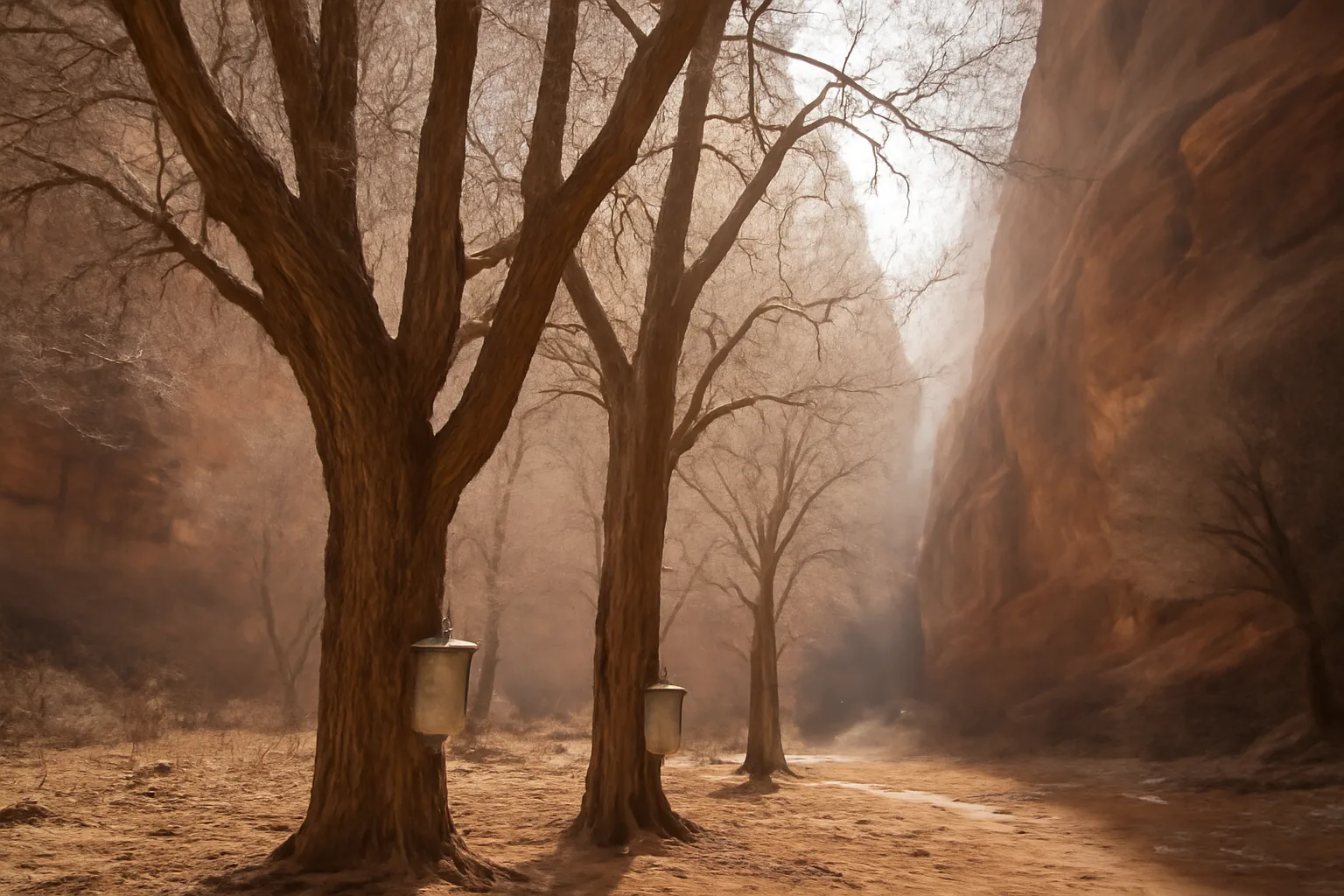
TL;DR
Utah has no dedicated sugarbush license, but food business rules, water rights, and land access permits still apply depending on your setup. The season runs roughly 4 to 8 weeks in late winter. Startup costs range from a few hundred dollars to tens of thousands by scale. This guide walks the real paper path, specific to Utah.
Does Utah even have a viable maple tapping season?
Yes, but it's narrow and you have to know where to look. Utah sits mostly outside traditional maple country, yet bigtooth maple (Acer grandidentatum) grows in canyon pockets along the Wasatch Front, the Uinta Mountains, and parts of the Dixie National Forest. These trees do produce sap. The sugar content runs lower than eastern sugar maple on average, though nobody has published a clean head-to-head study specific to Utah wild stands.
Tapping season here follows freeze-thaw cycles. Mid-February through late March is the usual window, sometimes bleeding into early April at higher elevations. That's 4 to 8 weeks in a good year. A hard winter that stays frozen too long, or a warm snap that rushes the trees to bud, can squeeze that window to two or three weeks. You cannot count on a full eight-week run every year.
If you want volume, you're working a wild-tree operation in canyon terrain, not a cultivated stand of eastern sugar maple. That changes everything: access, tree density, land permissions, and how much sap you can realistically collect.
Do you need a license for sugarbush in Utah?
Utah has no dedicated sugarbush permit or maple syrup producer license the way Vermont or New York do [1]. There is no single form that says "maple syrup operation." What you need turns on three questions. Whose land are you tapping? Are you selling the syrup? Are you processing it in a commercial kitchen?
If you tap trees on your own private land and eat the syrup at home, no license is required.
The moment you sell, the Utah Department of Agriculture and Food (UDAF) food business rules kick in. Maple syrup sold to the public falls under cottage food or food facility licensing depending on volume and sales channel [2]. Utah's cottage food law, Utah Code 4-5-101 through 4-5-102, allows certain home-produced food items to be sold directly to consumers without a full facility license, but you must confirm with UDAF whether maple syrup qualifies under the current definition and whether revenue caps apply to your situation [3].
Tapping on U.S. Forest Service land means you need a special use permit from the relevant ranger district before you put a single tap in. Tapping without that authorization is unauthorized use of federal resources [4]. Contact the Uinta-Wasatch-Cache National Forest or whichever district covers your land. Processing times and permit availability vary by district and the ranger assigned.
State Trust Lands administered by the School and Institutional Trust Lands Administration (SITLA) carry their own lease and permit requirements. SITLA manages roughly 3.4 million surface acres in Utah [5]. If your target trees sit on SITLA land, you'll need a commercial use authorization from them before operating.
What land access and water permits might you need?
Utah runs on prior appropriation water law. Water is not automatically yours just because it flows across your land or through your trees. Maple sap is tree-processed water, and in practice most small-scale hobby tappers don't file a water right for sap collection. But if you're pulling sap at commercial scale and worried about regulatory exposure, confirm with the Utah Division of Water Rights whether your operation triggers any filing requirement [6].
For USFS land, the special use permit process under 36 CFR 251 governs non-recreational commercial activity. The application goes to the district office, and fees and terms are set per permit [4]. There is no statewide posted fee for a sap-collection special use permit, because the USFS prices them individually based on acreage, resource impact, and duration.
Private land is simple. Get a written lease or written permission from the landowner. Verbal agreements work until they don't, and a single-page written license protects both parties.
County zoning can matter too. If you're building an evaporator building or sugarhouse on property, some Utah counties require a conditional use permit for agricultural processing structures. Call the county planning office in your specific county before you pour a foundation.
How much does a sugarbush operation cost in Utah?
There is no official state-published cost figure for a sugarbush operation in Utah, so what follows are real-world ranges from extension and industry sources, adjusted for Utah terrain.
At the hobby end (25 to 100 taps, gravity collection, small propane evaporator), startup equipment runs roughly $300 to $800 before any land costs [7]. That covers taps, tubing or buckets, a small evaporator pan, and a hydrometer. The University of Vermont Extension puts the break-even sap volume for small operations near 40:1 (sap to syrup, for sugar maple). Bigtooth maple in Utah may run 50:1 or higher, so you need more sap per quart of finished syrup [8].
At small commercial scale (200 to 500 taps, vacuum tubing, dedicated evaporator), the Cornell University sugarbush budgeting model puts startup equipment in the $8,000 to $25,000 range depending on evaporator size and whether you're buying used or new [7]. Tubing systems for rough canyon terrain cost more to install than flat orchard rows.
Annual operating costs beyond equipment include fuel for evaporation (propane or wood), any required permits, and labor. Propane evaporation costs roughly $0.35 to $0.60 per pound of water evaporated depending on local propane prices. Wood is cheaper but adds labor. Confirm current propane prices in your area before budgeting.
MapleSyrupPath's $129 Tap + Evaporator + Grade Kit is one entry-level option worth comparing if you're deciding whether to commit before building out a full setup. More detail at /start.
Land lease costs swing wide. USFS special use permit fees for small-scale operations have historically been minimal, but the district sets them case by case. Private land leases in Utah canyon areas don't follow a posted formula.
| Scale | Estimated startup equipment cost | Taps | Likely syrup output per season |
|---|---|---|---|
| Hobby (home use) | $300-$800 | 25-100 | 1-4 gallons |
| Small commercial | $8,000-$25,000 | 200-500 | 10-40 gallons |
| Mid-scale commercial | $30,000-$80,000+ | 1,000+ | 80+ gallons |
These are equipment-only estimates. Land, labor, permits, and processing facilities are additional.
How long does a sugarbush season take in Utah?
The tapping window in Utah runs roughly 4 to 8 weeks, concentrated between mid-February and late March for most Wasatch Front and Uinta foothill locations [9]. Higher elevation sites may push into early April. The trigger is alternating freeze-thaw cycles: nights below freezing, days above. When nighttime temperatures stop dropping below freezing consistently, sap flow slows and the season ends.
Bigtooth maple in Utah canyons tends to bud earlier than sugar maple at equivalent latitudes, which compresses the harvest window. You won't get the long, reliable season Vermont producers count on.
Processing time per week depends on your scale. A 100-tap hobby operation might generate enough sap for a half-day of evaporation per week. A 500-tap tubing system with vacuum could have you running an evaporator three or four days a week at peak flow. Sap will not wait. It ferments within 24 to 48 hours above about 40 degrees F, so you process what you collect or you lose it.
From first planning to first syrup, expect 12 to 18 months if you're starting from zero. That includes finding your trees in summer (tap marks or trail GPS), securing land access, buying equipment before the season, and running a test batch. Don't buy an evaporator in January expecting to run a commercial operation by March. The permit process alone for USFS land can take months.
What food safety and labeling rules apply in Utah?
If you sell maple syrup in Utah, UDAF regulates it as a food product. Syrup sold direct-to-consumer from a home or farmstand may qualify under cottage food exemptions, but you need to confirm current eligibility with UDAF, because the rules carry specific exclusions and revenue thresholds that can change by legislative session [2][3].
If your syrup goes to retail stores, farmers markets with resale intent, or restaurants, a food handler license and likely a licensed commercial kitchen are required. UDAF issues food facility licenses, and the application, fees, and inspection process run through their food regulatory program.
Labeling rules for maple syrup sold in interstate commerce fall under the USDA Agricultural Marketing Service grading standards [10]. Utah adopted these federal grade standards: Grade A with color classifications (Golden Delicate, Amber Rich, Dark Strong, and Very Dark Strong). If you're selling only within Utah, state law controls, but UDAF generally tracks the federal grades. Mislabeled or adulterated syrup can result in product seizure and fines.
The USDA AMS maple syrup grade standard states that "maple syrup is the liquid derived by concentration and heat treatment of the sap of the maple tree" and sets a Brix minimum at 66 degrees [10]. That's the line your syrup needs to hit before you call it maple syrup, and a refractometer is the tool that tells you whether you're there.
How do Utah bigtooth maples compare to sugar maple for syrup production?
The species difference matters, and you should go in with clear eyes. Sugar maple (Acer saccharum) is the gold standard: typical sap sugar content runs 2 to 3% in productive stands, with top trees hitting 4 to 5% [8]. Bigtooth maple (Acer grandidentatum) produces sap that Utah producers report at roughly 1.5 to 2.5% sugar, though no peer-reviewed study has published a large-sample Utah-specific figure. The honest answer is that data is thin.
The practical implication is your yield ratio. If sugar maple runs 40:1 (40 gallons of sap to make 1 gallon of syrup), bigtooth maple may run 50:1 or 60:1. That means more fuel, more time, and more sap volume to hit the same syrup output. At small scale, this is annoying. At commercial scale, it changes your break-even math a lot.
On the plus side, bigtooth maple produces a distinct flavor that some producers find appealing, with slightly different mineral and sugar profiles than eastern maple. There is a niche market argument for "Utah canyon maple syrup" as a regional specialty product. Whether that premium pricing holds up depends on your distribution channel and marketing effort, not anything the state guarantees.
For how neighboring states approach their own non-traditional sugarbush operations, see our guides on sugarbush renewal in colorado and sugarbush renewal in idaho.
What agencies do you actually contact to get started?
Here's the real list, not a generic "consult local authorities" brush-off.
For food business licensing: Utah Department of Agriculture and Food, Food Safety program. Ask specifically whether maple syrup qualifies under current cottage food rules and what the revenue cap is if so.
For land on the Uinta-Wasatch-Cache National Forest: the relevant ranger district office. Ask for the special use permits coordinator.
For SITLA land: School and Institutional Trust Lands Administration. Ask about commercial use authorizations for agricultural harvest activities.
For water rights questions: Utah Division of Water Rights at waterrights.utah.gov. Ask whether sap collection at your scale triggers any reporting or right-of-use requirement.
For county zoning (if you're building a processing structure): your county planning and zoning office. Utah has 29 counties, and rules vary a lot between them.
For tree identification help and extension resources: Utah State University Extension. USU has county offices across the state and can help with tree ID, sap testing, and basic production guidance.
No single agency coordinates all of this for you. The paper path means contacting at least two or three of these agencies depending on your setup. Start early, ideally the summer before your intended first season.
What common mistakes do first-year Utah sugarbush operators make?
Tapping at the wrong time is the biggest one. People see a warm February day and rush out with drills. If nighttime temperatures aren't reliably dropping below freezing, sap flow hasn't started in earnest. Tapping too early wounds the tree for a season that hasn't begun.
Underestimating fuel costs is common. Propane in Utah's rural canyon areas can run higher than valley averages, and evaporation eats a lot of it. Budget fuel before you buy an evaporator, not after.
Skipping the USFS permit and hoping nobody notices. Rangers do patrol canyon areas, and unauthorized tapping on federal land creates legal liability and can cost you permit approval for future seasons. It's not worth it.
Building evaporator infrastructure before confirming county zoning. Some rural Utah counties have simple rules. Others have specific requirements for agricultural processing structures. A quick call to the county planner before construction saves real money.
For how operators in states with more established maple industries handle first-year planning, the sugarbush renewal in connecticut guide and the sugarbush renewal in alaska guide cover useful parallels for non-traditional and northern operations.
Is a Utah sugarbush operation financially realistic?
At hobby scale, yes, as long as you're honest that you're not going to make money. A 50 to 100 tap backyard or canyon operation producing 2 to 4 gallons of syrup per season is a satisfying project that covers maybe a fraction of its own equipment cost in syrup value.
At small commercial scale (200 to 500 taps, bigtooth maple, canyon access), the math is harder. Lower sugar content means more inputs per gallon of output. Access costs in rough terrain add to labor. The retail price of high-quality, locally produced specialty maple syrup can run $20 to $40 per quart or higher in direct-to-consumer channels, which helps margins, but volume is limited by tree density and terrain.
Nobody has published a Utah-specific sugarbush enterprise budget. The closest applicable models come from USU Extension and Cornell's maple enterprise budgets for small-scale operations, and both point to multi-year break-even timelines even in favorable conditions [7]. In Utah, with lower-yield trees and harder terrain, that timeline stretches further.
If you want to compare the financial picture across different state regulatory and terrain environments, sugarbush renewal in arizona and sugarbush renewal in california cover two western states with comparable non-traditional maple contexts.
The honest take: Utah sugarbush is a passion project with commercial potential for the right niche producer, not a path to significant farm income in the near term. That could change as bigtooth maple production knowledge grows and specialty food markets develop, but that's speculation, not a bankable projection.
Where to go next: building your Utah sugarbush information kit
Start with tree scouting. Identify your bigtooth maple locations in summer or fall when leaves are present. GPS the trees, estimate density, and read the terrain for tubing or bucket access.
Next, clarify land status. Is it your land, private lease, USFS, BLM, or SITLA? The permit path branches completely on this answer.
Then contact UDAF about food business requirements specific to how you intend to sell (or not sell) your syrup.
For equipment decisions, the MapleSyrupPath $129 Tap + Evaporator + Grade Kit at /start is a low-cost way to test the process before committing to larger infrastructure. That's the sensible order of operations: verify you can tap, collect, evaporate, and grade before you build a sugarhouse.
Last, connect with USU Extension for local advice. They're the only in-state research institution publishing any guidance on Utah maple resources, and a county extension agent who knows your specific canyon terrain is worth more than any national guide, including this one.
Frequently asked questions
Do you need a license for sugarbush in Utah?
There is no dedicated sugarbush license in Utah. What you need depends on whose land you tap and whether you sell the syrup. Selling syrup triggers UDAF food business rules. Tapping on USFS land requires a special use permit. Tapping on SITLA land requires a commercial use authorization. Home use on your own private land with no sales has no specific license requirement, but confirm current rules with UDAF before selling anything.
How much does a sugarbush operation cost in Utah?
Hobby-scale startup equipment (25 to 100 taps) runs roughly $300 to $800. Small commercial equipment (200 to 500 taps) runs $8,000 to $25,000 depending on evaporator size and whether you buy used. Bigtooth maple's lower sugar content raises fuel costs per gallon of syrup compared to eastern sugar maple operations. Land access costs vary by permit type. No Utah-specific enterprise budget has been published; Cornell and USU extension models are the closest public benchmarks.
How long does sugarbush season last in Utah?
Roughly 4 to 8 weeks, typically mid-February through late March at most Wasatch Front and Uinta foothill elevations. Higher sites may run into early April. The season depends entirely on freeze-thaw cycles and ends when nighttime temperatures stop dropping below freezing. Bigtooth maple tends to bud earlier than sugar maple at similar latitudes, which can further compress the window in warm years.
Can you tap bigtooth maple trees in Utah for syrup?
Yes. Bigtooth maple (Acer grandidentatum) produces sap that can be boiled into syrup. Sugar content typically runs lower than eastern sugar maple, around 1.5 to 2.5% versus 2 to 3% or more for sugar maple, so you need more sap per gallon of finished syrup and burn more fuel. The flavor profile is distinct and potentially marketable as a regional specialty, but large-scale yield data specific to Utah is limited.
Do you need a water right to collect maple sap in Utah?
Utah is a prior appropriation water rights state. For small hobby-scale sap collection, most operators don't file a water right, and the Division of Water Rights does not appear to actively pursue small sap collectors. If you're operating at commercial scale and want to be certain of your legal standing, contact the Utah Division of Water Rights at waterrights.utah.gov and ask specifically whether sap collection triggers any filing requirement for your volume.
Can you tap trees on U.S. Forest Service land in Utah?
Only with a special use permit from the relevant ranger district. Tapping without authorization is unauthorized use of federal resources under 36 CFR 251. Contact the Uinta-Wasatch-Cache National Forest or whichever district covers your target area. Request the special use permits coordinator. Processing times vary by district and season, so apply well before your intended first tap date, ideally by fall of the prior year.
Does Utah have cottage food laws that cover maple syrup sales?
Utah has cottage food provisions under Utah Code 4-5-101 through 4-5-102 that allow some home-produced food items to be sold directly to consumers without a full facility license. Whether maple syrup currently qualifies, and what revenue caps apply, requires direct confirmation with UDAF's food safety program. Do not assume syrup is included based on general cottage food summaries; the specific product eligibility list matters.
What grade standards apply to Utah maple syrup?
Utah maple syrup sold commercially follows the USDA Agricultural Marketing Service maple syrup grade standards, which establish Grade A with four color and flavor designations: Golden Delicate, Amber Rich, Dark Strong, and Very Dark Strong. The USDA standard requires maple syrup to reach at least 66 degrees Brix to be labeled as maple syrup. A refractometer is the standard tool for testing Brix in the field.
Are there any Utah state grants or programs for maple producers?
No specific Utah state grant program for maple or sugarbush production is publicly listed as of this writing. USDA's NRCS offers some agricultural conservation programs that may apply to agroforestry operations, including the Environmental Quality Incentives Program (EQIP), but eligibility for maple-specific activities in Utah is not guaranteed and must be confirmed with the local NRCS office. Confirm current program availability at nrcs.usda.gov.
How do I find bigtooth maple trees in Utah to tap?
Bigtooth maple grows in canyon environments along the Wasatch Front (think Provo Canyon, American Fork Canyon), in the Uinta Mountains, and in portions of the Dixie National Forest in southern Utah. USU Extension and the Utah Division of Forestry, Fire and State Lands can help with identification. Scout in summer or fall when leaves are present; the distinctive large-lobed leaves and canyon habitat make them identifiable with a good field guide.
What is the sugar-to-sap ratio for Utah bigtooth maple?
Precise published data is scarce. Utah producers and informal sources suggest bigtooth maple sap runs roughly 1.5 to 2.5% sugar, compared to eastern sugar maple at 2 to 3% or more. At 2% sugar content, the sap-to-syrup ratio is about 50:1 (50 gallons of sap to produce 1 gallon of syrup). That means more evaporation time and fuel than a comparable eastern operation. Treat any single-source figure with caution; conditions vary by tree, elevation, and year.
How early should I plan before my first Utah tapping season?
Plan at least 12 to 18 months out if you need land permits. USFS special use permit applications benefit from a fall submission for the following spring season. Equipment should be ordered by December at the latest for a February start. Tree scouting, land confirmation, and agency contacts all benefit from a summer-before start. Rushing the process is the most common mistake in first-year operations across any state.
Sources
- Utah Department of Agriculture and Food: UDAF regulates food sales in Utah; no dedicated sugarbush license exists under state ag code
- Utah Department of Agriculture and Food, Cottage Food Information: Utah cottage food rules govern whether home-produced food including syrup can be sold direct-to-consumer without a full facility license
- Utah Legislature, Utah Code Title 4 Chapter 5 (Utah Agricultural Code, Food Sales): Utah Code 4-5-101 through 4-5-102 establishes cottage food exemptions for direct-to-consumer sales of certain home-produced food items
- U.S. Forest Service, Special Uses Program (36 CFR 251): Commercial activities on USFS land including sap collection require a special use permit under 36 CFR 251
- School and Institutional Trust Lands Administration (SITLA): SITLA manages approximately 3.4 million surface acres in Utah and requires commercial use authorizations for harvest activities on trust lands
- Utah Division of Water Rights, Utah State Engineer: Utah operates under prior appropriation water law; commercial-scale sap collection may require confirmation of water use authorization
- University of Vermont Extension, Maple: Sugar maple sap averages 2-3% sugar content and a 40:1 sap-to-syrup ratio; trees with higher sugar content reduce the ratio
- Utah State University Extension, Forestry: Bigtooth maple grows in Utah canyon environments; freeze-thaw season timing in the Wasatch region typically runs mid-February through late March